How to Sell Used Furniture in Israel: What Sells, for How Much, and Who Carries It
Shukshuk team · Updated September 2026
Furniture is the most annoying thing to sell: it is big, it is heavy, no chain takes it as a trade-in, and the buyer has to come to your home with a mover. That is why most sofas in Israel are not sold but dragged to the kerb. This guide is the other route: what is worth trying to sell at all, how to price without a made-up table, what to write so the buyer's first question is already answered, how the pickup ends without an argument, and the orderly path if it does not sell. You finish with a piece that is measured, photographed, priced and ready to list.
Four routes for furniture you no longer need, fastest to slowest
- How long
- Days to two weeks
- What you get
- Money
- Who carries
- The buyer, usually with a mover
- How long
- Usually a day or two
- What you get
- A quick clearance
- Who carries
- Whoever takes it
- How long
- By arrangement
- What you get
- The piece goes to a family
- Who carries
- Some charities collect
- How long
- On your area's collection day
- What you get
- Nothing
- Who carries
- You, as far as the kerb
| Route | How long | What you get | Who carries |
|---|---|---|---|
| Private sale (classifieds) | Days to two weeks | Money | The buyer, usually with a mover |
| Give away free | Usually a day or two | A quick clearance | Whoever takes it |
| Donate to a charity | By arrangement | The piece goes to a family | Some charities collect |
| Municipal bulky pickup | On your area's collection day | Nothing | You, as far as the kerb |
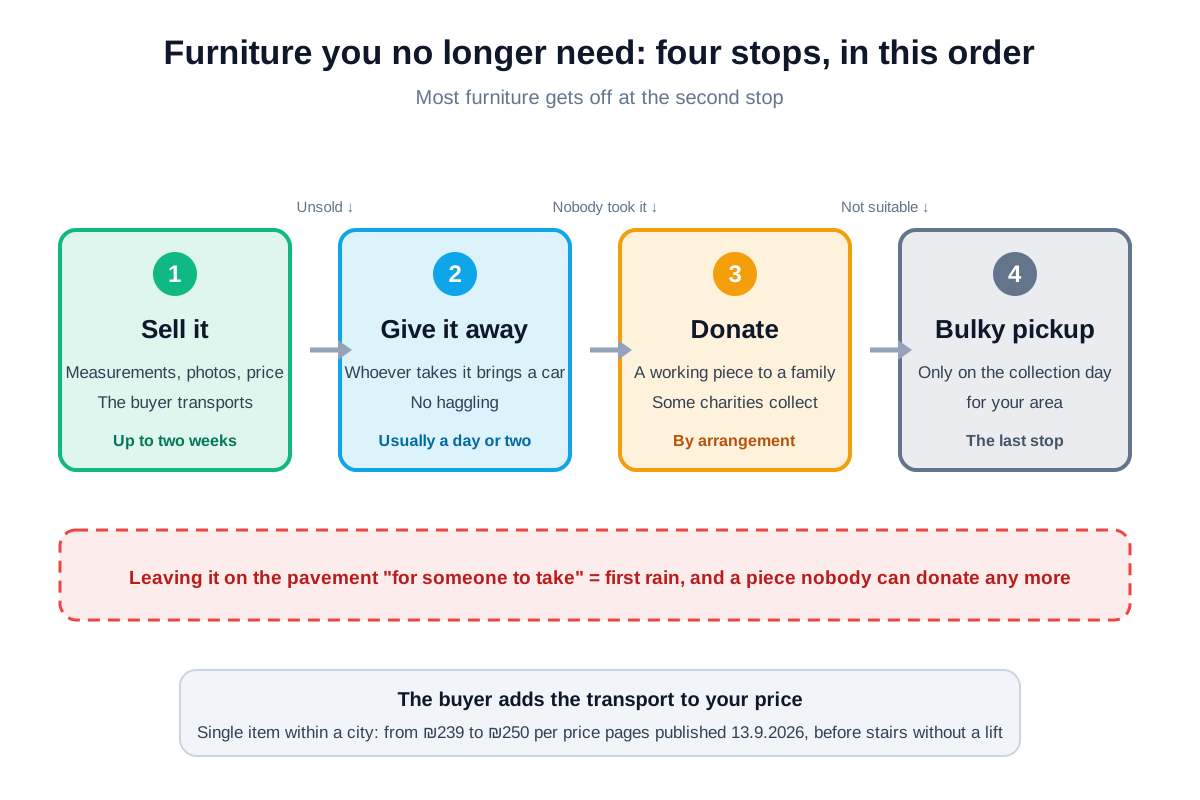
A single-item delivery within a city starts, per price pages published on 13.9.2026, at ₪239 (Start Moving) and ₪250 (Pickup Movers), before stairs without a lift and disassembly. The buyer adds that sum to your price in their head, so it is part of your pricing.
What actually sells, and what only looks like it should
The pattern on every Israeli board repeats itself, and it is not worth fighting. Sells: sofas in good condition without stains or tears, dining tables with their chairs, desks, relatively new beds and mattresses with a receipt, and any IKEA piece that has a name: KALLAX, BILLY, PAX, MALM, HEMNES. Buyers google the name, know exactly what it costs new, and can download the assembly instructions free from IKEA's site. A piece with a name is a piece that is easy to sell. Sells slowly or not at all: old sideboards and wall units, complete bedroom sets from the previous generation, display cabinets, painted wood that has peeled, and anything that needs two movers and a crane. Not because they are bad, but because the buyer pays more to transport them than they pay you. A used mattress is its own story: most buyers will not take one for hygiene reasons, and in most cases its route is giveaway or disposal, not sale. The rule that sorts everything: if the piece would cost you less new than it costs to transport, do not try to sell it. Give it away and save yourself two weeks of messages.
How much? The method, because there is no price list
There is no price list for used furniture in Israel, and a fixed percentage ("a used sofa is worth a third of new") is an invention. What there is, is a four-step method: 1. Today's new price. For an IKEA or chain piece, check the price of the same model on the site. For a piece from a carpenter or a shop that closed, the price of the closest thing. That is the ceiling, and no buyer will go above it. 2. The market. Find three to five listings for the same or a very similar piece, in the same city. An asking price is not a sale price, but if everyone asks ₪400 and you ask ₪900, your listing gets no messages. 3. Transport. The buyer adds the mover's fee to your price in their head. A single-item delivery within a city starts at ₪239 to ₪250 per two price pages published on 13.9.2026, and rises with every floor without a lift. A ₪300 sofa on the fourth floor with no lift is, to the buyer, a ₪600-plus sofa. A ground floor, a lift, or "I will help carry it down" are worth money, so they get a line in the listing. 4. Time. A piece that does not sell occupies a room. A price that brings a buyer within a week beats a "correct" price that sits for a month, and if there are no messages after a week, the price is too high, not the buyers. On haggling: almost every furniture buyer will try to knock the price down on the spot, standing in your living room with the mover. Decide your floor in advance, and say in the listing if the price is final.
The listing: measurements first, photos second
Every furniture buyer's first question is "what are the measurements", and a listing that does not answer it gets that question instead of an "I will take it". Measure width, depth and height in centimetres and put them in the title or the first line. For a sofa: how many seats and whether it opens into a bed. For a table: closed and extended. For a wardrobe: the number of doors, and whether it is dismantled or assembled. The name: if it is an IKEA or chain piece, write the model name. That is what the buyer searches for, and what Google will bring. The photos: in daylight, after cleaning, with no laundry on the sofa and no children in frame. One from the front, one from the side, one close-up of the fabric or wood, and one of every defect: scratch, stain, sagging cushion. A defect in the photo is a detail; a defect discovered in your living room is a reason to lower the price or leave. What else to write: approximate age, why you are selling ("moving", "bought a new one"), whether you have a receipt, floor and lift, when people can come to see it, and who dismantles. One sentence on transport ("collection by the buyer, second floor with lift") saves ten messages.
Transport and disassembly: who, when, and how much
The rule of the market: the buyer transports. You do not undertake to deliver, do not offer "a friend's van", and do not start looking for a mover on behalf of someone who has not paid. Whoever wants the piece books a mover or brings a vehicle. The figures that could be verified today: Start Moving advertises single-item transport "from ₪239", Pickup Movers "from ₪250", and both state that the price is set by the job. What moves it: floors without a lift, distance between cities, disassembly and reassembly, and whether a crane is needed. When a buyer asks "how much will the transport cost me", that is the range you can give honestly, without committing on any mover's behalf. Disassembly: a wardrobe or bed that is already dismantled travels cheaply and fits in a lift. If you dismantle, every screw and fitting goes into one bag taped to the largest part, with a photo of the piece assembled beforehand. For an IKEA piece, the assembly instructions are on its site by model name, free, and that is a sentence worth writing to the buyer. Do not carry alone. A sofa on the stairs is the classic route to a back injury, and if the buyer comes alone and asks for help, "I will help as far as the lift" is a reasonable limit. Whatever happens from the lift onwards is theirs.
A stranger in the living room: safety and payment
Selling furniture differs from selling a phone in one thing: the buyer comes to your home. A few simple rules. Before giving an address: a short phone call. Someone who refuses to talk and only writes, and someone who insists that "my courier will collect and I will pay by transfer", does not get an address. Payment happens in front of the piece, not before it. At the meeting: someone else at home if possible, the piece near the door if it is small, and no tours of the flat. The buyer looks, checks, sits on the sofa, opens a sofa bed, and then pays. Payment: cash, bit or PayBox, on the spot, before the piece leaves the door. "I will pay when we get home" is a sofa that left for free. A small deposit by bit to "hold" the piece is legitimate from a serious buyer, but a payment link the buyer sends you, or "I paid too much by mistake, refund the difference", are the standing templates of classifieds scams and have no real version. No-shows: this is the frustrating part of furniture. A buyer who arranged Saturday and did not come is the norm, not the exception. So: confirm on the morning of the meeting, do not take the listing down until the piece is out, and whoever arrives first with a mover takes it.
Two weeks later and nobody came
It happens, and often. The orderly route, in this order: 1. One significant price cut, not a series of tens of shekels. A listing that drops from ₪800 to ₪450 gets a new wave of viewers; one that drops to ₪750 does not. 2. Give it away. A working piece offered free usually disappears within a day or two, with no haggling and no carrying on your part, because whoever takes something free brings a vehicle. Shukshuk has a page of its own for this, "free", and a listing moves there with one sentence in the chat. 3. Donate. Charities such as Miyad Leyaad and Karmei Chesed pass working furniture on to families, and some collect from home by prior arrangement. Who takes what, and where: in our donation guide. 4. Municipal bulky pickup. Every municipality clears bulky waste from the kerb on a fixed day by area, and a piece put out on the wrong day sits on the pavement until the next collection and can draw a fine. When and how in your city: in the bulky-waste guide. What not to do: leave the piece on the pavement "for someone to take". Sometimes someone does. Usually it gets wet in the first rain and becomes waste that can no longer be donated.
FAQ
Where do you sell used furniture in Israel?
On classifieds boards and in groups, because no chain takes furniture as a trade-in. On Shukshuk you list a piece for free through the chat, with no commission, and if it does not sell you move it to the free-giveaway page in the same place. IKEA runs a second-hand platform called Preowned abroad (Madrid and Oslo, per an August 2024 report), and as of 13.9.2026 we found no such programme in Israel.
How much should I ask for a used sofa?
There is no price list, and a single number would be invented. The method: today's price of the new model as the ceiling, three to five listings for a similar sofa in the same city as the middle, then subtract what the buyer will pay for transport, which starts at ₪239 to ₪250 for a single item within a city per price pages published on 13.9.2026, and rises with every floor without a lift.
Who pays for transport when selling furniture?
The buyer. That is the rule of the market, and it is worth stating in the listing explicitly ("collection by the buyer") together with the floor and whether there is a lift. When a buyer asks what it will cost them, you can point to the published price pages: a single item from ₪239 or ₪250, before surcharges for floors and disassembly.
Should I dismantle a wardrobe before selling it?
A dismantled wardrobe or bed travels cheaply and fits in a lift, so it is easier to sell. If you dismantle: screws in one bag taped to the largest part, and a photo of the piece assembled beforehand. For an IKEA piece, the assembly instructions are available free on its site by model name.
The piece did not sell, what now?
In this order: one significant price cut; if still nothing, give it away free (usually gone within a day or two); if that fails too, donate to a charity that passes furniture on to families; and only at the end municipal bulky pickup on your area's collection day, not the day before.
Sources

See also
The transport prices are starting prices published by two movers on their own sites on 13.9.2026, and both state that the price is set by the job; they are not a quote. There is no price list for used furniture, and this guide gives a method, not a number. What sells and what does not is the pattern we see on the boards, not a survey.