Toilet Running? The Simple Fixes
Shukshuk team
A toilet that keeps refilling after a flush, or hisses continuously, isn't just annoying: it can waste hundreds of liters a day. In most cases you can diagnose and fix it yourself with basic hand tools, without taking apart anything beyond the tank lid. This guide starts with diagnosis, then walks through replacing the flapper and adjusting the float: with one important warning: a concealed, in-wall tank is not a DIY job.
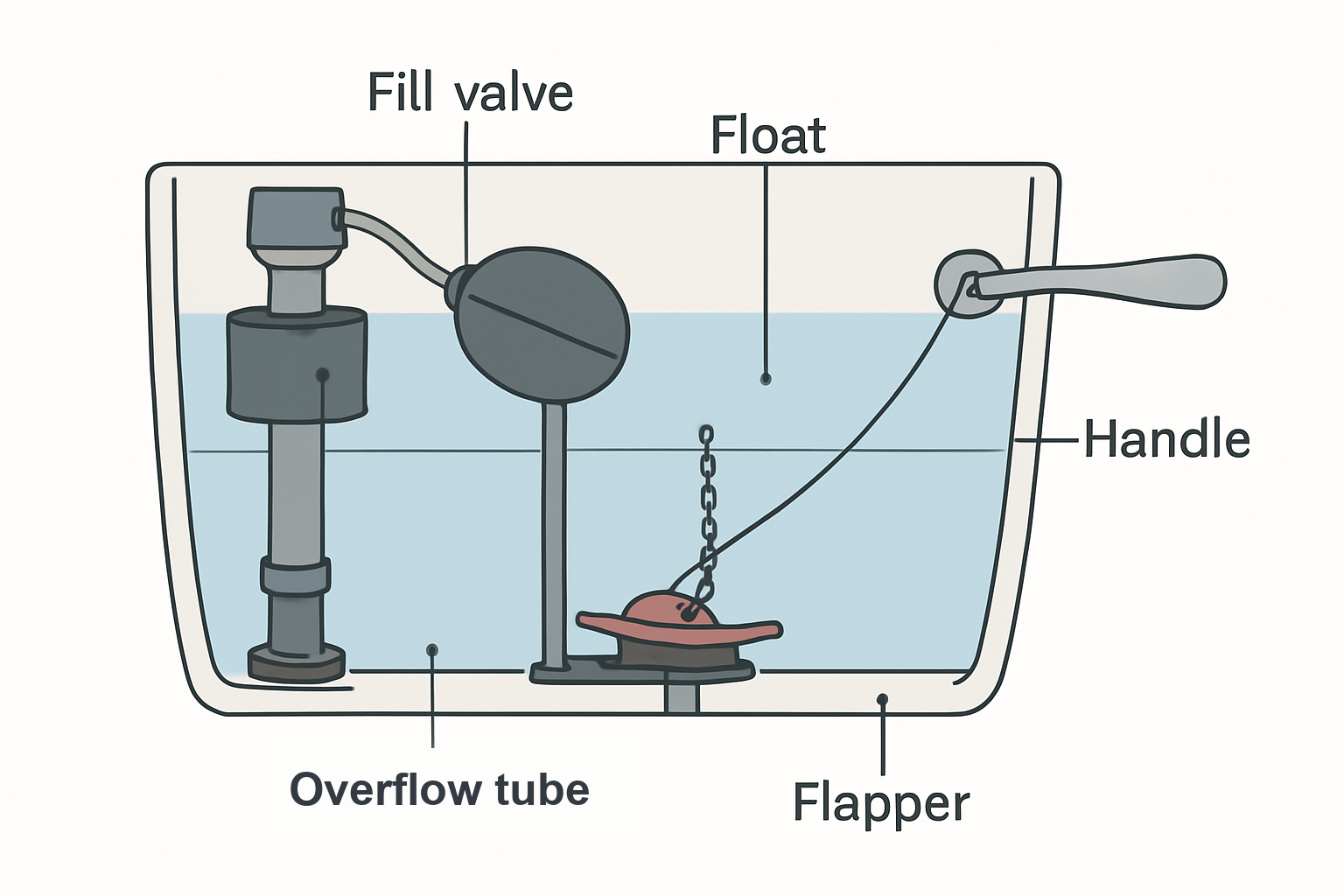
Tools You Need
An adjustable wrench or slip-joint pliers (for the supply line and lock nut only) · a replacement flapper and/or fill valve, matched to size · a sponge, towel, and bucket · food coloring for the leak test · scissors to trim the chain. No power tools, everything is hand-twist or clip-on.
Diagnosis: Dye Test First
1. Don't flush for about 15 minutes. Remove the tank lid, add 5–10 drops of food coloring to the tank (not the bowl). Wait 10–20 minutes without flushing. If color appears in the bowl, the flapper or its seal is leaking; go to the flapper replacement section. If no color appears, the problem is likely the fill valve or the float. Flush afterward so the dye doesn't stain. 2. Check the water level. The waterline in the tank should sit about 2–3 cm below the top of the overflow tube. Water at or above the tube means the float is set too high and the tank is overflowing into the bowl. Persistent hissing after the tank fills points to the fill valve itself. 3. Manual float check. Gently lift the float by hand, if the running stops, adjustment is enough; if not, the fill valve is worn and needs replacing.
Flapper Replacement: 10–20 Minutes, a Cheap Part
1. Shut off the water at the valve behind the toilet (turn clockwise). Never skip this step. 2. Lay the tank lid flat on a towel (it chips easily). Flush and hold the handle down to drain the tank, then sponge out what's left. 3. Unhook the chain from the lever arm, note which hole it came from. 4. Remove the old flapper, lift the ears off the pegs on the overflow tube, or for a ring-style flapper, slide it up and off. No tools needed. 5. Check the underside of the old flapper for warping or mineral buildup, and clean the valve seat: the ring the flapper sits on. A dirty seat leaks even with a brand-new flapper. 6. Match the size, bring the old flapper to the store for comparison; 2 inches is common, 3 inches on newer toilets. A mismatch won't seal. 7. Seat the new flapper flat and centered, and reattach the chain with about 0.5–1.5 cm of slack when the flapper is closed: too taut and it won't seat, too loose and it can get caught under the flapper or cause a weak flush. Trim the excess chain. 8. Turn the water back on, test-flush, and confirm it's silent after refilling.
Float / Fill-Valve Adjustment
Target: the water should stop about 1–2.5 cm below the top of the overflow tube (or at the marked fill line). Ball-float on an arm (older toilets), gently bend the arm down to lower the level, or use the adjustment screw on the valve. Float-cup style (newer toilets), turn the adjuster on the valve shaft one full turn at a time, flush, and recheck. If adjusting doesn't stop the running, replace the fill valve (about 40 minutes, a cheap part): shut off the water, drain and sponge the tank, place a bucket underneath, disconnect the supply line, unscrew the lock nut under the tank, swap in the new valve, hand-tighten gently (plastic nuts crack if overtightened), set the float height, reconnect, and test.
Why It Matters: The Real Cost of Waste
A continuously running toilet wastes an average of about 200 gallons a day, roughly 757 liters, according to Denver Water (a major US utility), which prices that at $270–$470 a year. The US EPA notes that household leaks waste an average of about 180 gallons a week (roughly 680 liters), that toilets are usually the culprit, and that fixing simple leaks saves about 10% on the water bill. In other words, an old flapper worth a few shekels that never got replaced can cost you tens or even hundreds of shekels a year in wasted water.
Prevention
Run the dye test every 3–4 months, a flapper leak is usually silent · replace the flapper about every 5 years (EPA WaterSense's explicit recommendation) · avoid in-tank chlorine tablets, or use a chlorine-resistant flapper (tablets degrade rubber) · listen after every flush: hissing longer than 30 seconds means the valve isn't seating · exercise the shutoff valve gently once or twice a year so it doesn't seize · check the supply line for drips: braided stainless outlasts rubber.
Stop: Call a Plumber
A concealed, in-wall cistern (Geberit-style): the mechanism sits behind the wall plate; taking it apart incorrectly risks damage inside the wall. This guide covers exposed tanks only. Water reaching the floor or walls (pooling at the base, stains, soft flooring): a wax ring, tank bolts, or a cracked fixture; water in a wall or subfloor causes mold and rot within days. A corroded or seized shutoff valve, don't force it; close the apartment's main valve instead and have it replaced. Hissing or leaking continues after both a flapper replacement and a fill-valve adjustment/replacement. A wobbling toilet, gurgling in other drains, or a sewage smell: beyond the tank components.
What a Plumber Costs
Fixing it yourself saves a call-out fee for what is usually a small issue, but once a concealed tank, a wall leak, or a seized valve is involved, it's safer to call a plumber right away rather than risk it. See the full plumber-cost guide below for detailed pricing by issue type.
FAQ
How do I know if the flapper is leaking?
Run a simple dye test: add a few drops of food coloring to the tank (not the bowl), wait 10–20 minutes without flushing, and check if color shows up in the bowl. If it does, the flapper is leaking. Run this test every 3–4 months, since a flapper leak is usually silent.
Can I fix a concealed (in-wall) cistern myself?
Not recommended. A concealed tank sits behind the wall plate, and this guide covers exposed tanks only. Taking a concealed tank apart incorrectly risks damage inside the wall, call a plumber for that one.
Sources
- EPA WaterSense, Fix a Leak Week (dye test, 5-year flapper replacement)
- EPA WaterSense, residential toilets (180 gal/week; flapper is the usual culprit)
- Denver Water, stop your running toilet (200 gal/day; $270–$470/yr)
- This Old House, how to fix a running toilet
- Bob Vila, how to replace a toilet flapper

See also
This is a general guide, if you are unsure, or if any of the "Stop" conditions above apply, call a plumber and do not continue with DIY.