The Tax Authority real-estate deals record: how to check what flats on your street sold for
Shukshuk team · Updated September 2026
Anyone who buys or sells a flat in Israel must report the deal to the Tax Authority within 30 days, and the price is recorded. That record has existed for decades, but until now you could only see it one deal at a time. In September 2026 the volunteer project over.org.il ("נדל״ן לעם") released it in full: 3,844,200 deals from 1998 to 17 September 2026, across 1,336 localities. It is the closest thing to an answer to "what does a flat on my street really cost", because it is built on sales that happened, not asking prices. This guide explains what is in the data and what is not, where it misleads if you read it carelessly, and how to check it in practice, including what Shukshuk has built on it. Everything was checked on 28 September 2026; sources are at the bottom.
What was released, and why it is the best data on flat prices
Israel's real-estate tax law requires both seller and buyer to declare a deal within 30 days of it taking place, and today the declaration can only be filed online. So nearly every sale of a flat in Israel enters the Tax Authority's record, with the date, the price, the type of property and the share sold. The Authority shows the deals on its real-estate information site and on the government real-estate site, nadlan.gov.il, which you can search by map, address, neighbourhood or block and parcel. What changed in September 2026 is that the whole record is now available as a single file, so things that were impossible before can be calculated: trends over 28 years, comparisons between streets, and valuations built on real sales on the street itself.
What each deal contains, and what is missing
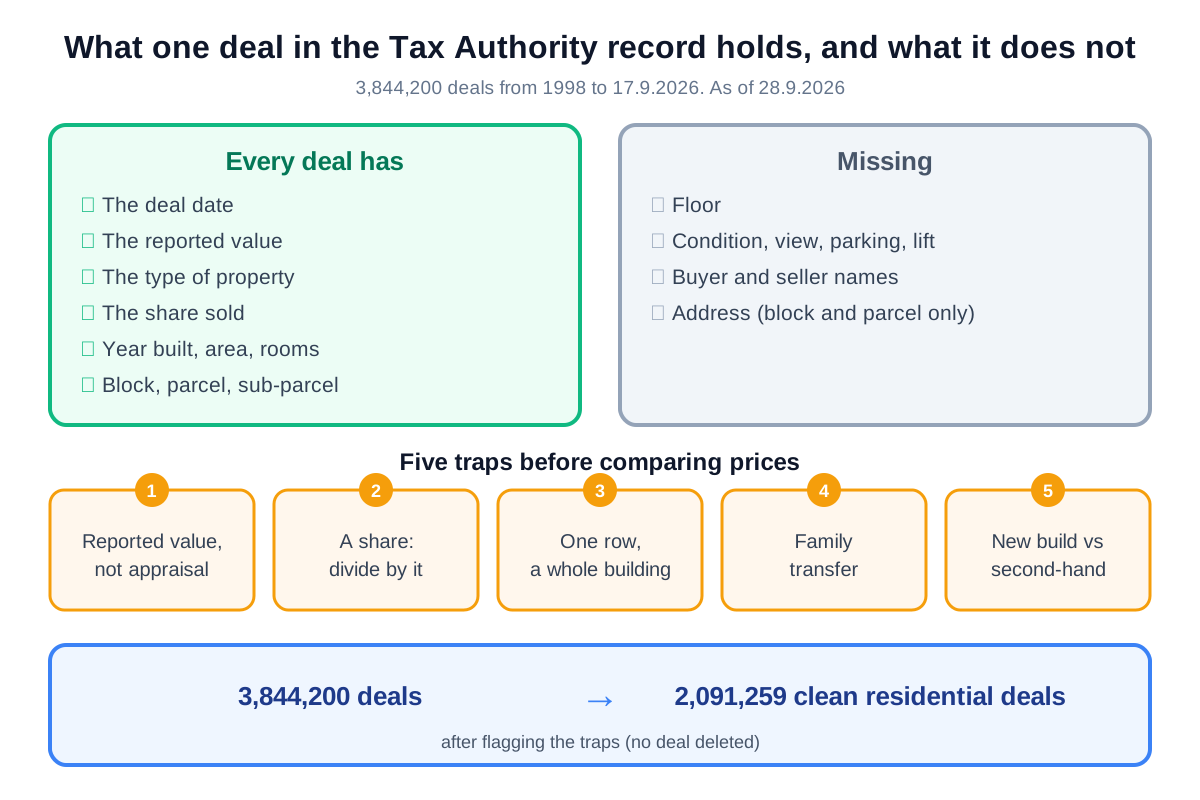
Each row holds: the deal date, the reported value, the nature of the deal (such as "flat in an apartment building" or "semi-detached cottage"), the share of the property sold, the year built, the property's area and number of rooms, and the land-registry identity: block, parcel and sub-parcel (in an apartment building the sub-parcel is usually the flat itself). What is missing matters just as much. There is no floor. No condition, view, parking or lift. No names, so the record does not reveal who bought or sold. And no address: deals are identified by block and parcel only, and knowing the street takes a cross-match with another source (Shukshuk cross-matched the government real-estate site's deals, which name the street, and the Survey of Israel parcel layer). About 17.5% of deals also lack a locality code.
Five traps in reading the prices
1. The reported value is not an appraisal. It is the amount the parties declared, which may or may not include things like furniture or attached parking. 2. A share of a property. When two partners each sell half, or heirs sell a third, the row shows the price of that share. The whole flat's price is the amount divided by the share sold. Price per m² computed without that correction comes out two or three times too low. 3. One row, a whole building. Some deals are the sale of a building, or several flats for one price. One such row can move an average by millions, which is why you look at medians, not averages. 4. Deals within a family. A transfer between relatives at a token price is recorded like any other sale. A price far below the street's is usually one of these, not a bargain. 5. New build versus second-hand. A first sale from a developer is priced differently from a 40-year-old flat on the same street. Check the year built before comparing. At Shukshuk we delete no deal, but we flag each of these traps and leave those deals out of price calculations: of 3.84 million deals, about 2.09 million "clean" residential deals remain, and every number on the site is based on them.
How to check what flats on your street sold for
The government real-estate site (nadlan.gov.il): type an address, neighbourhood or block and parcel and see the deals on the map. This is the official way to check a single deal. The full over.org.il record: for anyone who wants the raw data, to search by locality or block and parcel, or to download the whole file. Shukshuk street pages: every street with enough deals has a page with a chart of the median price per m² and number of deals per year since 1998, the recent sales, and a list of the buildings on the street. Herzl Street in Rehovot, for example, has about 850 residential deals recorded since 1998. You can also simply ask Shukshuk's chat "what did 4-room flats on X street sell for", and it answers from the same data, with a link to the source.
What the data makes possible: what Shukshuk built
Street and building history: about 7,600 street pages and some 210,000 buildings and parcels with deal histories. The building is the most detailed level we show: deals by date, rooms, size and price, without saying which flat. Street-level estimates: when you name a street, the estimate is built from sales of similar flats on that street (or within about 400 metres) over the last three years, adjusted to today's prices. Tested on 2026 sales that were not used to build the method, the median error fell from about 16% (a city-wide median) to about 9%. Alerts on new deals: you can ask us to tell you when a new sale is reported on your street. The data is refreshed monthly. Urban renewal: every city's price page lists its declared urban-renewal complexes, from the Ministry of Construction and Housing, with their status and number of homes. One thing we do not do: rate a listing's price as "fair" or "expensive". Next to a listing we show only a factual line about sales on the street, and a seller can ask to see them privately while pricing.
Example: ten years of prices in Tel Aviv
In the clean deals, the median price per m² of Tel Aviv flats was about ₪34,500 in 2016 and about ₪54,000 in 2026 (to September), a rise of about 57% in ten years. In the middle there is a clear jump in 2021, a year in which the number of deals also nearly doubled (8,832 against 4,764 the year before). This is exactly the kind of question the record answers well: a trend over years, in a city, neighbourhood or street. It answers a question about a single flat less well, because it lacks floor, condition and view.
FAQ
Is it legal to publish what a flat sold for?
Yes. Deal prices are shown to the public on the government real-estate site and on the Tax Authority's real-estate information site. The record does not include buyers' or sellers' names.
Is the price in the record the real price?
It is the amount the parties declared to the Tax Authority, not an appraisal. For a sale of a share, a transfer within a family or a sale of several flats together, the raw number misleads, so check the share sold and look at medians.
Why does my street show few deals?
Perhaps few flats really sold there, or some of the street's parcels were not linked to its name: the record is identified by block and parcel, and the link to a street comes from cross-matching other sources.
How current is the data?
Deals reach the record with a delay, since the report is due up to 30 days after the deal. On Shukshuk the data is refreshed monthly.
Sources
- Kol Zchut: declaring the sale or purchase of a real-estate right (report within 30 days)
- The government real-estate site
- Israel Tax Authority: real-estate information
- over.org.il, "נדל״ן לעם": the full deals record
- odata.org.il: the real-estate deals dataset (government real-estate site)
- data.gov.il: urban-renewal complexes, Ministry of Construction and Housing