Rabbit Care: A Complete Guide for New Owners
Shukshuk team
A rabbit is far more than "a small, quiet cage animal": it's a social, curious animal with particular dietary and physical needs. This guide summarizes the basics of caring for a house rabbit and what matters for keeping one in Israel.
A Home Plus an Exercise Area: Not Just a Hutch
A rabbit needs a spacious living space, plus regular access to a large exercise area for daily activity: a small cage or hutch alone is not enough. Rabbits need room to run, jump and stretch out fully every day.
Diet: Hay Comes First
About 80–85% of an adult rabbit's diet should be good-quality hay, always available, alongside a limited amount of pellets and fresh leafy greens daily. Avoid muesli-style mixes with separate seeds and grains to pick through, they encourage selective eating and an unbalanced diet.
Continuously Growing Teeth and Gut Stasis
A rabbit's teeth grow continuously throughout its life, and a fiber-rich (hay-based) diet is essential for wearing them down properly. Rabbits are also prone to a dangerous condition called gut stasis, a slowdown or stoppage of the digestive system that can be life-threatening. Find a rabbit-savvy vet in advance, rather than waiting for a problem to arise.
Social Needs: Rabbits Shouldn't Live Alone
Rabbits are naturally social animals. The recommended setup is a bonded pair of neutered/spayed rabbits rather than a single rabbit, neutering also reduces territorial and aggressive behaviors that can make bonding between rabbits harder.
How to Handle a Rabbit Correctly
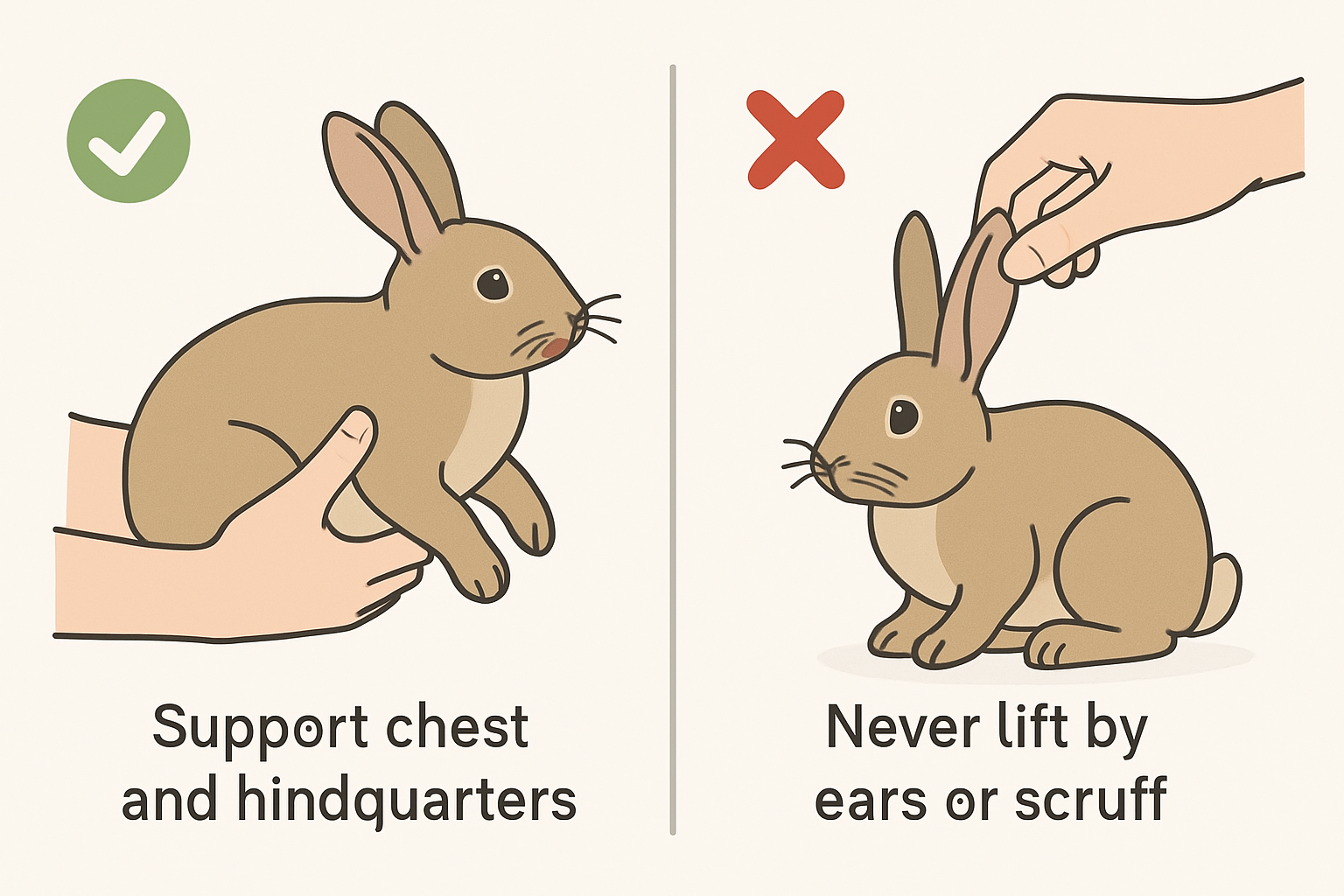
Always lift and support a rabbit's whole body at once, never grab or lift it by the ears or by the scruff. Rabbits can be seriously injured, including spinal injury, if held or dropped incorrectly.
Spaying/Neutering and Lifespan
Spaying/neutering is recommended for both health and behavioral reasons, and helps rabbits bond socially with each other. A house rabbit typically lives 8 to 12 years, a longer commitment than many people assume.
Israel: The Law, Heat and Common Mistakes
There is no rabbit-specific law in Israel; the Animal Welfare Law, 5754-1994 applies to rabbits like any kept animal. The 2009 regulations for keeping non-farm animals mainly govern commercial operations, pet shops and petting zoos, not private home-keeping. Rabbits are heat-sensitive and cannot tolerate extreme heat; keep them in a ventilated, shaded, cool spot, especially in summer, and never leave a rabbit in a parked car. Common mistakes: keeping a single rabbit long-term without a companion, feeding muesli instead of hay, and incorrect handling that causes injury. As with any pet, adopt rather than buy, and plan a vet budget in advance.
FAQ
Can a rabbit live alone?
It's not recommended, rabbits are naturally social, and the preferred setup is a bonded pair of neutered/spayed rabbits rather than a single rabbit.
How do you safely pick up a rabbit?
Support the whole body at once and never lift or hold a rabbit by its ears or scruff, this prevents injury.
Is there a rabbit-specific law in Israel?
No dedicated law exists; the 1994 Animal Welfare Law applies to rabbits like any animal, and the 2009 regulations mainly address commercial operations like pet shops and petting zoos.