How to Sell a Used Fridge or Washing Machine in Israel: Price, Transport, and What to Do If Nobody Wants It
Shukshuk team · Updated September 2026
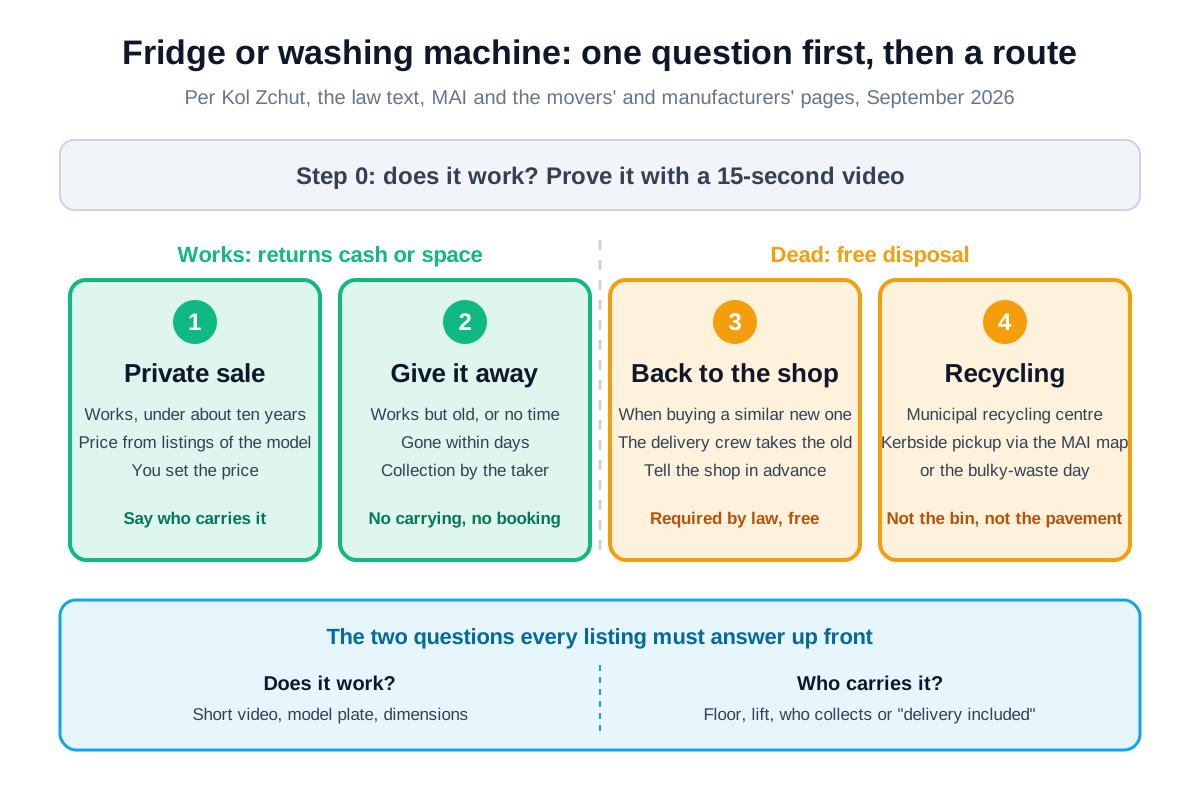
A fridge or a washing machine is the hardest thing in the house to sell: heavy, does not fit in a car, and nobody buys an appliance they are not sure works. So most listings get stuck on two questions the seller never answered up front: does it work? and who carries it? This guide follows the order of someone standing in front of the machine: what is worth trying to sell and what is not, the four routes and what each returns (cash, floor space, or a free pickup the law entitles you to), how to price when there is no price list, what moving a fridge really costs, how to move one without burning out a compressor or wrecking a drum, and what a listing that sells within a week looks like. At the end the appliance has an address, and you have your kitchen back.
Four routes, and what each one returns
- What you get
- Cash, at a price you set
- Who it suits
- A working appliance, under about ten years old, from a known brand; listing on Shukshuk is free
- What you get
- Floor space, usually within days
- Who it suits
- A working but old appliance, or no time to deal with it; "free" listings on Shukshuk
- What you get
- Free pickup from your home at delivery, by law
- Who it suits
- Anyone buying a similar new appliance; tell the shop in advance
- What you get
- Responsible disposal, free on most routes
- Who it suits
- A dead appliance: municipal recycling centre, kerbside pickup in municipalities signed with MAI, or the municipal bulky-waste day
| Route | What you get | Who it suits |
|---|---|---|
| Private sale on a board | Cash, at a price you set | A working appliance, under about ten years old, from a known brand; listing on Shukshuk is free |
| Giving it away | Floor space, usually within days | A working but old appliance, or no time to deal with it; "free" listings on Shukshuk |
| Hand it to the shop when buying new | Free pickup from your home at delivery, by law | Anyone buying a similar new appliance; tell the shop in advance |
| Recycling | Responsible disposal, free on most routes | A dead appliance: municipal recycling centre, kerbside pickup in municipalities signed with MAI, or the municipal bulky-waste day |
Every detail was checked on 16.9.2026 against Kol Zchut, the law text, the MAI website and the movers' and manufacturers' own pages; sources at the bottom. No resale price for a used appliance appears here, because there is no price list we would stand behind; there is a method instead.
Check first: what is worth trying to sell, and what is not
A buyer of a used appliance pays for one thing: certainty that it works. Everything else (age, brand, size) only moves the price. So the first question is not "what is it worth" but "can I prove it works". Worth selling: a fridge that cools and freezes without unusual noise and without ice building up in the freezer, a washing machine that finishes a full cycle, spins and does not leak. It helps a lot if the brand is known, the appliance is under about ten years old, and the dimensions fit a standard niche (a fridge 60 or 70 cm wide, a machine 60 cm wide or a slim 45 cm one). An appliance bought in the last few years that works perfectly is the easiest sale, even if the only reason you are selling is that the new flat's niche is smaller. Not worth trying: an appliance that does not work or "works, but", because nobody buys a future repair. A very old fridge that still works is also a problem: it uses a lot of electricity, and anyone who knows that will not pay. Both go to the giveaway route or to recycling, not to a listing. Before photographing: clean thoroughly, including the fridge door seals and the detergent drawer, and smell it. A smell of mould or fish is the most common reason a buyer who has already arrived leaves without buying. Find the model plate: a sticker inside the fridge (usually on the inner wall) or on the back of the machine and inside the door opening. The model number is what the buyer will search for, and what you will search for when pricing.
Route 1: a private sale, and the two questions the listing must answer
The only route that returns cash. It works for an appliance that works, provably, at a price that justifies the buyer's transport cost. The first question, "does it work?", is answered with a video: 15 seconds of the fridge running with a thermometer or a frozen glass of water in the freezer, of the machine turning and spinning. A video like that answers every buyer's first message in advance, and a listing with one gets fewer "does it still work?" and more "when can I come". The second question, "who carries it?", is the one that kills most deals, so it goes in the listing rather than coming up on the phone. Three options, all legitimate: the buyer arranges transport (the price is lower, and this is the usual case); you arrange transport and the price includes it (the phrase "delivery included" appears in buyers' searches because it solves their biggest problem); or the appliance is collected from the floor, not from inside the flat. What not to write: "we can arrange something", because that tells the buyer the problem is theirs. Where: on Shukshuk you list appliances free through the chat, with no commission, and enquiries come straight to you. On other boards the listing is built the same way, so the work is done once. The handover: the buyer comes, sees the appliance running, and pays before it leaves the door, in cash or an instant transfer while you watch. Do not unplug a fridge before the buyer has seen it working.
Route 2: giving it away, the fastest route
An appliance that works but is old, or one you have no time to sell, disappears within days when listed as free. "Second-hand fridge, free" is a phrase people genuinely search for: students, first flats, building-committee kitchens and small offices. On Shukshuk that is the "free" page (link below), and neighbourhood groups work well for this too. The rules are the same as for a sale: say whether it works, photograph it, measure it, and state clearly that collection is on the taker and from which floor. Someone taking it free arrives with a friend and a vehicle; someone who does not was never serious. The big advantage over throwing it out: the appliance keeps working for someone instead of being dismantled, and it is the only route that requires you neither to carry nor to book anything with a municipality.
Route 3: buying new? The shop must take the old one, free
This is the route most people do not know exists, and it is written into law. Under the Environmental Treatment of Electrical and Electronic Equipment and Batteries Law, 5772-2012 (section 30), a retailer selling electrical equipment suitable for household use must let the buyer hand over, at the time of sale or of delivery, a similar old appliance, without charging for it. What that means in practice, per Kol Zchut (updated 9.6.2025): you buy a new fridge, and the delivery crew that brings it takes the old one from your home on the same visit, free. It applies when the old appliance is from a different manufacturer and when it is a different size, and it applies to online purchases too. The shop must tell you about this option at the point of sale, and it is worth telling the shop in advance that there is an appliance to collect, so the crew arrives prepared. Where they may charge: an "exceptional pickup", such as a third-floor flat with no lift, a crane, or dismantling, and only if you agreed to the cost in advance. A retailer may also refuse equipment that is hazardous to handle. You can also bring the old appliance to the shop itself when buying (Kol Zchut, updated 26.5.2025), if it is similar in quantity and weight to what you bought. If the shop refuses: contact the public enquiries office of the Ministry of Environmental Protection, or the recognised compliance body the shop works with. Usually, mentioning the law on the phone is enough.
Route 4: recycling, for an appliance that does not work
An appliance does not go in the bin and does not just sit on the pavement: it is electronic waste, and even without buying new there are three proper ways to dispose of it, per the website of MAI (the recognised recycling body): - Bring it yourself to the municipal recycling centre. Call the 106 municipal hotline or find the nearest point on the MAI map. This requires transport, so it suits anyone with a pickup truck and a friend. - Kerbside collection, only in municipalities that have signed an agreement with MAI: on the MAI map choose the large-appliance pickup option, fill in the request form, and receive an SMS with the contractor's details. Put the appliance on the kerb on the morning of the pickup day only, not before. - The municipality's bulky-waste day: most cities have a fixed collection day for large items, and fridges and washing machines are included in most municipalities. Days and rules by city are in our bulky-waste guide (link below). What not to do: put a fridge on the pavement on a random day. It may stand there a week, and in many municipalities that is an offence carrying a fine. An old fridge waiting on the pavement with its door shut is also a danger to children; if it must wait, take the door off or fix it open.
Pricing: no price list, one method
There is no price table for used appliances, and anyone looking for one finds only other people's listings. But those listings are exactly the method. 1. Search the boards for the exact model number (from the plate). Three to five listings of the same model, or of an equivalent model from the same brand and capacity, give a range. If there are none, search by brand and capacity ("Samsung fridge 500 litres"). 2. Place yourself in the range by three things: age (newer, higher), exterior condition (scratches and dents lower it, even if everything works), and transport (a "delivery included" price can be higher, because it saves the buyer a few hundred shekels, see the next section). 3. Check what the equivalent new appliance costs today. If a similar new model is on sale at a price not far from what you are asking, the buyer will prefer new with a warranty. Used sells when the gap from new justifies the risk. 4. The real test comes after posting: a week without an enquiry on a working appliance with a video means the price is wrong or the transport question is unresolved, not that "nobody saw it". Cut once, clearly, or change the transport terms. What is not worth trying: "purchase price divided by two". A large appliance loses most of its value the day it leaves the shop, because from that day it has no warranty and no delivery.
Transport: what it costs, and who pays
Single-item moving is a "from" market, and the prices movers advertise do not agree with each other, so we quote them as they are, from the movers' own pages (read on 16.9.2026): - Hovala (hovala.co.il) publishes a table by fridge capacity: 300 litres ₪180 to ₪280, 500 litres ₪250 to ₪320, 800 litres ₪350 to ₪420, and "from ₪180" as the minimum. - Aviv Moving advertises "from ₪250" for a small fridge, "from ₪300" for a medium one and "from ₪400" when a crane is needed. - The Pro guide (1.12.2024) lists the surcharges that turn "from" into a real price: about ₪100 for a floor without a lift, about ₪200 for removing and refitting doors, about ₪300 for a distance of up to 40 km, about ₪250 more in the summer season, and a crane at ₪400 to ₪500 an hour. The practical conclusion: a fridge or machine travelling a few streets, in a building with a lift, costs a few hundred shekels; without a lift, far away, or with a crane, it approaches a thousand. And that is exactly why the transport question decides the sale: an appliance you ask ₪600 for costs the buyer ₪1,000 with transport, and they do that sum before they call. What it means for the listing: if you arrange transport, get quotes from two movers (give the floor, lift and distance) before writing "delivery included", and build it into the price. If the buyer arranges it, state the floor and whether there is a lift, because that is what they will ask their mover. And do not carry a fridge down the stairs yourself: by the table above it weighs 60 to 130 kg, and most home-moving injuries come from exactly that.
How to move without wrecking it: fridge upright, machine with its bolts
Fridge. Per GE's moving instructions (a fridge manufacturer), switch the fridge off a couple of hours before the move so the evaporator defrosts (Israeli movers recommend unplugging 24 hours before; the difference between the two is mostly how much ice is in your freezer), empty it, tape shelves and drawers in place, and secure the door shut. In the van it should stand: GE write that French-door, bottom-freezer, compact and built-in models must stay upright, and only top-freezer and side-by-side models may be laid down if there is no choice. After lying down, stand the fridge upright before plugging in for as long as it lay, and after more than a day, 24 hours. The reason: compressor oil moves into the pipework when the unit lies down, and switching on immediately can finish the compressor. A mover who lays a fridge on its side "because that is how it fits" does so at the buyer's expense, and that is what the buyer will check when they call you two days later. Washing machine. Per Whirlpool's support page: shut the water valves, disconnect the hoses over a bucket (water remains in them), and unplug. Then the thing everyone forgets: the transit bolts. A new washing machine arrives with bolts in the back that lock the drum, they are removed at installation, and anyone moving a machine without putting them back risks the drum and suspension, because the drum swings freely and hits the inside. If you kept the bolts (usually in a bag with the manual), screw them back in before the move; Whirlpool recommend a technician, but it is a screwdriver-and-spanner job. If the bolts are lost, order a set for the model or at least pad the drum from inside with towels. Move upright only. At the destination: remove the bolts before the first run, level the machine, connect, and run a short empty cycle. Dryer, dishwasher, oven: same principles, without the bolts. The essentials are to disconnect, empty and secure the doors.
The listing that sells an appliance
Title: brand, type, capacity, and age. "Samsung fridge 500 litres, 2020, works perfectly" or "Bosch 8 kg front-loader washing machine, 2019". The model number in the body, because that is how it is searched for. Photos: the front closed, open with the light on (fridge) or the drum (machine), the model plate, and every scratch or dent close up. A photo of an appliance full of food or laundry does not sell; empty and clean it first. Video: 15 seconds of it working. It replaces ten messages. Dimensions: width, depth and height in cm, because the buyer's niche is their second question. For a machine, the depth with the door too. Condition in plain words: "works, never repaired", "door seal replaced in 2024", "scratch on the right side, hidden in the niche". Things the buyer will discover anyway are better read from you. Transport, on its own line: "3rd floor with lift, collection by buyer" or "delivery included in the centre". And the city and neighbourhood, because a mover prices by distance. With all of that in place, the listing answers everything a buyer asks before calling, and whoever does call is coming to buy.
FAQ
How much is a used fridge worth?
There is no price list. The method: search the boards for the model number or an equivalent model (same brand and capacity), three to five listings give a range, and place yourself in it by age, exterior condition and transport. Compare with the sale price of a similar new model, because beyond a certain gap the buyer will prefer new with a warranty.
Does the shop have to take my old fridge when I buy a new one?
Yes. Under the Environmental Treatment of Electrical and Electronic Equipment and Batteries Law (section 30) the retailer must let you hand over a similar old appliance at the time of sale or delivery, free of charge, even if it is from another manufacturer and even for online purchases. They may charge only for an "exceptional pickup" (for example a third floor without a lift, or a crane) and only with your prior consent. Tell the shop in advance that there is an appliance to collect.
How much does it cost to move a fridge?
By the movers' own pages (16.9.2026): "from" ₪180 to ₪250 for a small fridge in a building with a lift, ₪250 to ₪420 by capacity, plus about ₪100 per floor without a lift, about ₪300 for a distance of up to 40 km, and ₪400 to ₪500 per crane hour. The movers' prices disagree, so ask for two quotes with the floor, lift and distance.
Where do I dispose of an old fridge that does not work?
Not in the bin and not on the pavement on a random day. Three ways: bring it to the municipal recycling centre (106 hotline or the MAI map), book a kerbside pickup through the MAI map in municipalities signed with them (out on the morning of the pickup day only), or use the municipality's bulky-waste day. And if you are buying new, the shop takes the old one free.
Can a fridge be laid down for transport?
Better not. Per GE, French-door, bottom-freezer, compact and built-in models must stay upright; top-freezer and side-by-side models may be laid down if there is no choice. After lying down, stand the fridge upright before plugging in for as long as it lay, and after more than a day, 24 hours, so the compressor oil settles back.
What do I do about the washing machine's transit bolts?
Put them back before the move. The bolts at the back lock the drum, and a machine moved without them risks the drum and suspension (Whirlpool). Before that, shut the water, drain the hoses into a bucket and unplug; move upright only; at the destination remove the bolts before the first run.
How do I sell a used washing machine fast?
Answer in the listing the two questions every buyer asks: a short video of the machine turning and spinning, and a clear transport line (floor, lift, who collects or "delivery included"). Add brand, capacity, year, model number and dimensions, and price from listings of the same model. Listing on Shukshuk is free, and a working machine with a video usually sells within days.
Sources
- Kol Zchut, collection of electrical waste from the customer's home (free at delivery, exceptional pickup, online sales; updated 9.6.2025; Hebrew)
- Kol Zchut, returning an old electrical product when buying a new one (updated 26.5.2025; Hebrew)
- Nevo, Environmental Treatment of Electrical and Electronic Equipment and Batteries Law, 5772-2012 (section 30, retailer duty; Hebrew)
- MAI, public FAQ (recycling centres, kerbside pickup in signed municipalities; Hebrew)
- MAI MAP, find a collection point and the large-appliance pickup form (Hebrew)
- Hovala, what moving a fridge costs (price table by capacity; Hebrew)
- Aviv Moving, fridge transport ("from" prices; Hebrew)
- Pro, fridge transport price: surcharges for floors, distance, season and crane (1.12.2024; Hebrew)
- GE Appliances, refrigerator moving instructions (upright, defrost, stand time before plugging in)
- Whirlpool, moving a front-load washer (shipping bolts, draining, upright)

See also
The details about the law, recycling and movers were read from the sources listed on 16.9.2026 and may change; mover prices are prices the movers advertise themselves, not a quote. The moving instructions are summarised from manufacturers' pages; the instructions for your own model take precedence. This guide is not a valuation of any particular appliance.