Where to Give a Dog or Cat You Cannot Keep in Israel: Who Takes Them, What the Law Requires, and How to Find the Next Home Yourself
Shukshuk team · Updated September 2026
A child's allergy, a flat that bans animals, a divorce, old age, a dog that bites. The reasons are real, and the question typed into Google is always the same one: where to give it. The short answer is that almost no body in Israel "takes" a pet from its owner, and those that do have conditions; the route that works in most cases is finding the next home yourself, with a few rules that protect the animal and you. This guide goes through the alternatives worth checking first, what the law requires (abandonment is a criminal offence, and passing on a dog requires a new licence), the three routes and what each asks of you, and what to do with a cat, rabbit or hamster, which have fewer addresses. Every phone number and condition was read from the organisations' own sites on 20.9.2026; sources at the bottom.
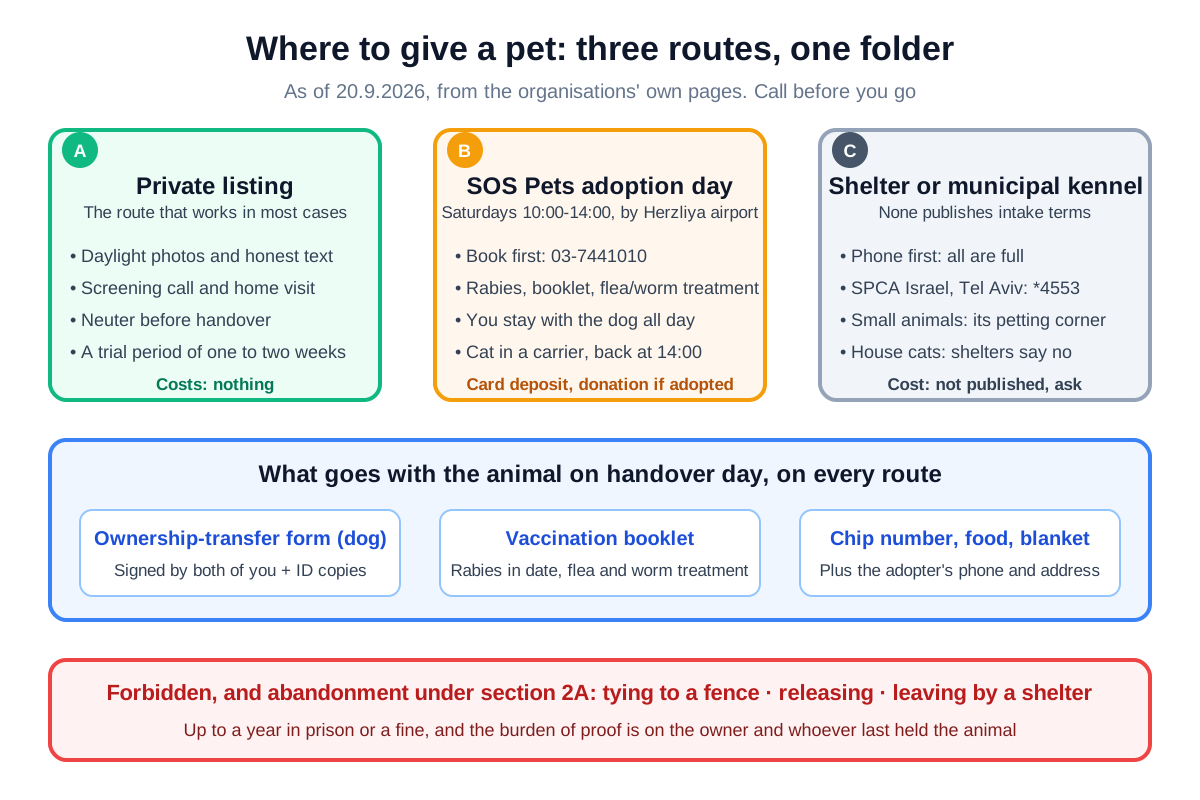
The three routes and what each demands. As of 20.9.2026, from the organisations' own pages
- Who it suits
- A healthy dog, cat or small pet; you have weeks, not days
- What to bring
- Photos, honest text, screening questions, the ownership-transfer form and vaccination booklet on handover day
- What it costs
- Free; neutering before handover at your expense
- Who it suits
- A vaccinated, healthy dog, or a cat in a carrier; you are free for a full day
- What to bring
- Phone booking in advance, vaccination booklet, flea and worm treatment, lead or carrier
- What it costs
- A card deposit on entry, and a donation if adopted
- Who it suits
- An emergency, a small animal (rabbit, guinea pig, hamster), or a dog you cannot keep another day
- What to bring
- A phone call first: no shelter publishes intake terms, and all are full
- What it costs
- Not published; ask by phone
| Route | Who it suits | What to bring | What it costs |
|---|---|---|---|
| Private rehoming through a listing | A healthy dog, cat or small pet; you have weeks, not days | Photos, honest text, screening questions, the ownership-transfer form and vaccination booklet on handover day | Free; neutering before handover at your expense |
| SOS Pets adoption day (Saturdays, by Herzliya airport) | A vaccinated, healthy dog, or a cat in a carrier; you are free for a full day | Phone booking in advance, vaccination booklet, flea and worm treatment, lead or carrier | A card deposit on entry, and a donation if adopted |
| A shelter or the municipal kennel | An emergency, a small animal (rabbit, guinea pig, hamster), or a dog you cannot keep another day | A phone call first: no shelter publishes intake terms, and all are full | Not published; ask by phone |
Not on the list: tying to a fence, "releasing", leaving by a shelter gate. Since 2005 abandoning an animal is a criminal offence carrying up to a year in prison, and the burden of proving you did not abandon it is on you.
Before giving up: the alternatives to check in the first week
Most surrenders start from a problem with a cheaper fix than separation, and it is worth checking, because rehoming itself takes weeks. Allergy: a doctor's diagnosis before deciding it is the animal (not every runny nose is the dog), and meanwhile frequent bathing, an air purifier, a bedroom without the pet. A dog that bites or destroys: a trainer or behaviourist, and more walks; a large share of "behaviour problems" is energy with nowhere to go. Moving: look for a flat that allows pets before giving up the pet, and arrange temporary fostering with a friend or relative for the gap. Cost: buy food in bulk, skip what is not needed, and use the charities' clinics (Let the Animals Live runs clinics in Ramat Gan and Ashkelon), which are cheaper than a private practice. The owner's illness or old age: a legitimate reason by any standard, in which case go straight to the routes below. Fostering: Let the Animals Live runs a foster programme for animals waiting for a home. It is not a solution for someone who wants to give up their pet, but for a temporary problem (hospitalisation, reserve duty, a move) it is worth asking about fostering before surrendering for good. What does not help: the vet clinic. A clinic provides medical care and does not take in animals, and their sites say so. Do ask the vet whether they know someone looking.
What the law says: abandonment is an offence, and passing on a dog requires a new licence
Abandonment. The Animal Welfare Law (Protection of Animals), 1994, section 2A: the owner of an animal, or whoever holds it, shall not abandon it. The section was added by an amendment the Knesset passed on 14.12.2005. Two things in it matter to anyone rehoming: the penalty is up to one year in prison or the fine set in section 61(a)(3) of the Penal Law (section 17(b)), and the burden of proof is reversed: when an animal is found abandoned, it is for its owner and whoever last held it to prove they did not abandon it. In other words, if your animal turns up on the street, you have to prove it was not you. Leaving it by a shelter is abandonment too, and SOS Pets says so explicitly on its page. Licence and transfer of a dog. Under the Dog Supervision Law, 2002: nobody may hold a dog over three months old without a valid licence (section 2(a)); the municipal veterinarian issues it (section 3(a)), on condition that the dog is chipped and vaccinated against rabies (section 3(b)). And the section that concerns rehoming: a dog whose owner holds a licence and which passes to other owners requires the new owner to obtain a new licence (section 3(e)), and the owner reports the transfer of the dog to other owners (section 8(e)). How it is done in practice, per the Tel Aviv municipality and a vet clinic that explains the process: fill in the dog ownership-transfer form, both sides sign, attach copies of both ID cards (in Tel Aviv: mandatory), preferably the last licence too, and send it to the municipal veterinarian. The new owner pays the licence fee to their own local authority. Until the form is processed the dog is registered to you, and if it is abandoned or bites, the question comes to you. So sign the form on handover day, not "later". Two numbers worth knowing: a neutered dog gets a discount of up to about 80% on the licence fee in Tel Aviv (other authorities do similarly; check yours), which is an argument for the adopter. And rabies: a puppy is vaccinated at three months and again one to three months later, and a dog that has had two or more vaccinations is vaccinated every two years. Without a current vaccination there is no licence, and the dog will not be accepted at an adoption day. Cats and small animals: no licence or chip requirement, so no form. The abandonment section applies to them exactly as to a dog.
Route A: find the next home yourself
This is the route that works in most cases, and the one the charities themselves recommend: SOS Pets writes that finding a new home is the right, responsible and humane way. The order: 1. The close circle first. Family and friends who know the animal are the safest home, because they know what they are getting and you can visit. 2. A listing. Three to five photos in daylight, at the animal's eye level, no filters; and text that tells the truth: age, sex, neutered or not, vaccinations, temperament (good with children? with cats? left alone?), and why you are rehoming. An honest listing brings fewer enquiries and better ones. Post it here in the pets category as a give-away (free), and in parallel on your city's adoption page. 3. Screening. The Noah association advises vetting the candidate before handing over, and doing a home visit. On the phone ask: where they live and who else is at home, whether they had an animal before and what happened to it, who cares for it during work hours, and what they will do if it does not work out. Anyone annoyed by the questions is not the one. 4. Neuter before handover. Do not give an animal for adoption that is not neutered or spayed (Noah). It stops your animal becoming a puppy machine for someone who wanted "just one", and cuts the licence fee for the adopter. 5. A trial period. Agree in advance on a week or two during which the animal can come back to you with no argument; SOS Pets works this way at its adoption days too (an adopter can return within two weeks, and the person rehoming takes the animal back). 6. Handover day. For a dog: the ownership-transfer form signed by both of you with ID copies, the vaccination booklet, the chip number, the food it is used to, its blanket. For a cat: the vaccination booklet, a carrier, and the same food and blanket. Write down the adopter's name, phone and address. Money: you do not sell a pet, and anyone asking for a "commitment fee" mostly gets dealers. What you do ask for is evidence, for instance a neutering appointment if it has not been done.
Route B: an SOS Pets adoption day
SOS Pets is the only charity we found that publishes an orderly process for someone who wants to rehome a dog or cat, and it is not "leaving the animal with them" but an adoption day at which you present it to adopters. The rules, from their page: When and where: every Saturday, 10:00 to 14:00, on Menachem Begin Street by Herzliya airport (Kfar Shmaryahu). Arrive between 9:30 and 10:30 only, and book in advance on 03-7441010 or 03-7441111. Who stays: a dog's owners stay with it all day and talk to the adopters; that is part of the method, because you are the only ones who can describe it. A cat's owners may leave it and return at 14:00 if it has not been adopted. Conditions: a dog over five months must have a rabies vaccination; the vaccination booklet; flea and worm treatment; the animal entirely healthy, with no signs of illness; a chipped dog comes with an ownership waiver; a dog on a collar and lead, a cat in a carrier. Money: a card deposit on entry, and if the animal is adopted, a donation to the charity. If the adopter returns it within two weeks, you take the animal back and try again. What it gives you: an audience of adopters who came for that, and the charity's screening instead of yours. What it does not give: a solution for someone who cannot keep the animal until next Saturday.
Route C: a shelter or the municipal kennel, and why you phone first
The first thing to know: no major shelter in Israel publishes terms for taking an animal from its owner. The adoption pages are detailed, the surrender pages do not exist, and that is no accident: the shelters are full, and they would rather you found a home yourself. So this route always starts with a phone call and a direct question: "I have a dog/cat I cannot keep. Do you take them, on what terms, and at what cost?" The addresses (as of 20.9.2026, from their sites): - SPCA Israel, 159 Herzl Street, Tel Aviv: *4553 or 03-5136500. Open Sun to Thu 08:00 to 19:00 (Wed until 16:00), Fri 08:00 to 14:00. It is also the address for small animals: according to the society's article (10.8.2020), rabbits, guinea pigs and hamsters that arrive get a veterinary check and are taken into its petting corner. - Haifa SPCA: 04-8729696. Their adoption fee is ₪850 for a dog (vaccinations, chip and neutering included), and compassion adoption of a dog over 7 is free; that tells you what an adopter saves by going through you. - Jerusalem SPCA (JSPCA), Atarot industrial zone: 02-585-4465. Adoption fees up to ₪1,000 for a dog and ₪500 for a cat. - Let the Animals Live: *3703. Runs fostering and clinics in Ramat Gan and Ashkelon. - Your municipal kennel. In Haifa, for example: 45 Ofir Street, 04-8621968, Sun to Thu 08:00 to 14:00, Fri 08:00 to 11:00. In other authorities search for "veterinary service" on the municipality site. The municipal kennel is the address the law points to, and a dog surrendered there with a rabies vaccination has a good chance of adoption, but intake terms and cost vary by city, and that is what you ask. What to bring to any of them: the vaccination booklet, the chip number, a signed ownership-transfer form (for a dog), and an honest account of the animal. What not to do: do not leave an animal at the gate, at night, in a box. That is abandonment under the law, even at a shelter.
A cat: why shelters say no, and what works
Anyone searching "where to give a cat" quickly finds that most shelters answer no, and there is a reason beyond lack of space. The Hadera cat rescue home publishes its intake policy explicitly: it takes only street cats in distress, and not cats with a domestic past, because house cats fail to adapt to shelter conditions, sink into depression and stop eating. Even when there is room (capacity there, for example, is 350 cats), a house cat in a shelter is not a rescue. So for a cat the routes are: private rehoming (route A), which works especially well for cats because cat adopters are looking for exactly "a calm, neutered house cat"; and the SOS Pets adoption day, which takes cats in a carrier and lets you return at 14:00 (route B). In the listing say whether the cat is neutered, vaccinated, indoor-only or goes out, and how it is with other cats and children. What is forbidden: "releasing" a house cat to the street, even by a feeding station. A cat that grew up indoors does not know how to live outside, and it is abandonment under section 2A, with the same reversed burden of proof.
Rabbit, guinea pig, hamster, parrot
Small animals have the fewest addresses, and so the most abandonments: SPCA Israel writes that rabbits are bought on impulse, without understanding what they need, and reach it when the family loses interest. The addresses that do exist: - Private rehoming: the main route here too. A listing that includes the cage or enclosure that comes with the animal gets far more enquiries, because the adopter saves the big expense. Rabbits that lived as a pair are rehomed as a pair. - SPCA Israel (*4553): per its article, rabbits, guinea pigs and hamsters that arrive are taken into its petting corner after a veterinary check, and neutered. Call before coming. - Species enthusiast groups (rabbits, parrots) on social networks: that is where the people who know how to care for them are, and sometimes fostering too. What not to do: do not "release" a rabbit or hamster in a garden or park. A house animal does not survive outdoors, and it is abandonment under the law like any other animal.
FAQ
Is it allowed to just release a cat or leave a dog by a shelter?
No. Under section 2A of the Animal Welfare Law (amendment of 14.12.2005), an owner or holder shall not abandon an animal; the penalty is up to a year in prison or a fine under the Penal Law, and if the animal is found abandoned, the burden of proving you did not abandon it is on you and on whoever last held it. Leaving it by a charity or a feeding station is abandonment in every sense.
How do I transfer ownership of a dog to the person adopting it?
Fill in the dog ownership-transfer form, both sides sign, attach copies of both ID cards (and preferably the last licence), and send it to the municipal veterinarian. Under section 3(e) of the Dog Supervision Law the new owner must obtain a new licence, and pays the fee to their own authority. Do it on handover day: until then the dog is registered to you.
Which charity takes a dog or cat from its owner?
No major shelter publishes intake terms for owners, and all are full; call and ask directly (SPCA Israel *4553, Haifa 04-8729696, Jerusalem 02-585-4465, Let the Animals Live *3703, or your municipal kennel). What is published is SOS Pets' Saturday adoption day by Herzliya airport, booked in advance on 03-7441010, where you present the animal to adopters.
What do I need to bring a dog to an SOS Pets adoption day?
Per their page: advance booking, arrival between 9:30 and 10:30 on Saturday, a rabies vaccination for a dog over five months, the vaccination booklet, flea and worm treatment, an entirely healthy animal, a collar and lead (or a carrier for a cat), an ownership waiver if there is a chip, and a card deposit on entry. A dog's owners stay with it until 14:00 and talk to the adopters.
Why will a cat shelter not take my cat?
Because a house cat does not do well in a shelter: the Hadera cat rescue home publishes that it takes only street cats in distress, since cats with a domestic past fail to adapt, sink into depression and stop eating. For a cat the route is an honest listing for a private adopter, or an SOS Pets adoption day, which accepts cats in a carrier.
Should I ask for money for the animal?
You do not sell a pet, and a request for a "commitment fee" mostly attracts dealers. What you ask for is evidence: neutering before handover (Noah: do not give an unneutered animal), a screening call and a home visit, a signed ownership-transfer form for a dog, and a trial period in which the animal comes back to you if it does not work out.
Sources
- Nevo, Dog Supervision Law, 2002 (sections 2(a), 3(a), 3(b), 3(e), 8(e))
- Nevo, Animal Welfare Law (Protection of Animals), 1994 (section 2A abandonment, section 17(b) penalty)
- Anonymous for Animal Rights, abandonment is an offence (amendment passed 14.12.2005)
- Tel Aviv-Yafo municipality, dogs: ownership transfer, licence fee (up to about 80% off for neutered), rabies vaccination
- Vets4Life, transferring dog ownership: the form, signatures, ID copies and fee
- SOS Pets, animals are not abandoned: the Saturday adoption days, conditions and deposit
- SPCA Israel, contact (*4553, 159 Herzl St Tel Aviv, opening hours)
- SPCA Israel, rabbits get abandoned too (10.8.2020: rabbits, guinea pigs and hamsters taken into the petting corner)
- Haifa SPCA, dogs for adoption (₪850, compassion adoption over 7, 04-8729696)
- Jerusalem SPCA, JSPCA (adoption fees up to ₪1,000 for a dog and ₪500 for a cat, 02-585-4465)
- Let the Animals Live (*3703, fostering, clinics in Ramat Gan and Ashkelon)
- Haifa municipality, the municipal kennel (45 Ofir St, 04-8621968, hours)
- Hadera cat rescue home, cat intake policy (does not take cats with a domestic past)
- Vets.co.il, reasons for giving up a pet and the options (alternatives; a clinic does not take animals)
- Noah association, giving dogs and cats for adoption (neuter before handover, vet the adopter, chip in the agreement)

See also
The phone numbers, hours and intake conditions in this guide were read from the organisations' sites on 20.9.2026 and may change; call before you go. The law sections are quoted from Nevo and are not legal advice. This guide does not recommend any particular organisation and does not promise that any of them will take an animal.