How to Sell Used Books in Israel: What Is Worth Selling, to Whom, and What to Do With the Rest
Shukshuk team · Updated September 2026
Books are the easiest thing to accumulate at home and the hardest to get rid of: throwing them out feels wrong, and most people who try to sell them find a month later that nobody called. The reason is almost always one of two: they tried to sell books that have no buyer, or they tried to sell one by one what should go as a lot. This guide follows the order of someone standing in front of the shelf: what is actually in demand and what is not, the four routes and what each one returns (cash, a voucher, or just shelf space), how to price when there is no price list but one clear anchor, what a listing that sells books looks like, what to do with textbooks and religious books, and what the post costs. At the end the shelf is in three piles and each one has an address.
Four routes, and what each one returns
- What you get
- Cash, at a price you set
- Who it suits
- Complete series, sought-after titles, current-edition textbooks, lots by genre; listing on Shukshuk is free
- What you get
- Cash on the spot, usually after a home visit
- Who it suits
- Whole libraries and estates: Intellect buys from 200 books up, Green Brothers buy estates from the home
- What you get
- A discount voucher for your next purchase, not cash
- Who it suits
- Reading copies in good condition; walk into a branch, free home pickup for large quantities
- What you get
- Shelf space and a clear conscience
- Who it suits
- Am HaSefer collect from 30 books up; street libraries (a few at a time), kindergartens and schools, nursing homes; "free" listings on Shukshuk
| Route | What you get | Who it suits |
|---|---|---|
| Private sale on a board | Cash, at a price you set | Complete series, sought-after titles, current-edition textbooks, lots by genre; listing on Shukshuk is free |
| Sale to a dealer | Cash on the spot, usually after a home visit | Whole libraries and estates: Intellect buys from 200 books up, Green Brothers buy estates from the home |
| Hand-in to a second-hand chain | A discount voucher for your next purchase, not cash | Reading copies in good condition; walk into a branch, free home pickup for large quantities |
| Giving away | Shelf space and a clear conscience | Am HaSefer collect from 30 books up; street libraries (a few at a time), kindergartens and schools, nursing homes; "free" listings on Shukshuk |
Every detail was checked on 15.9.2026 against the chains', shops' and organisations' own websites; sources at the bottom of the page. No per-book price appears here, because there is no price list we would stand behind; there is an anchor and a method instead.
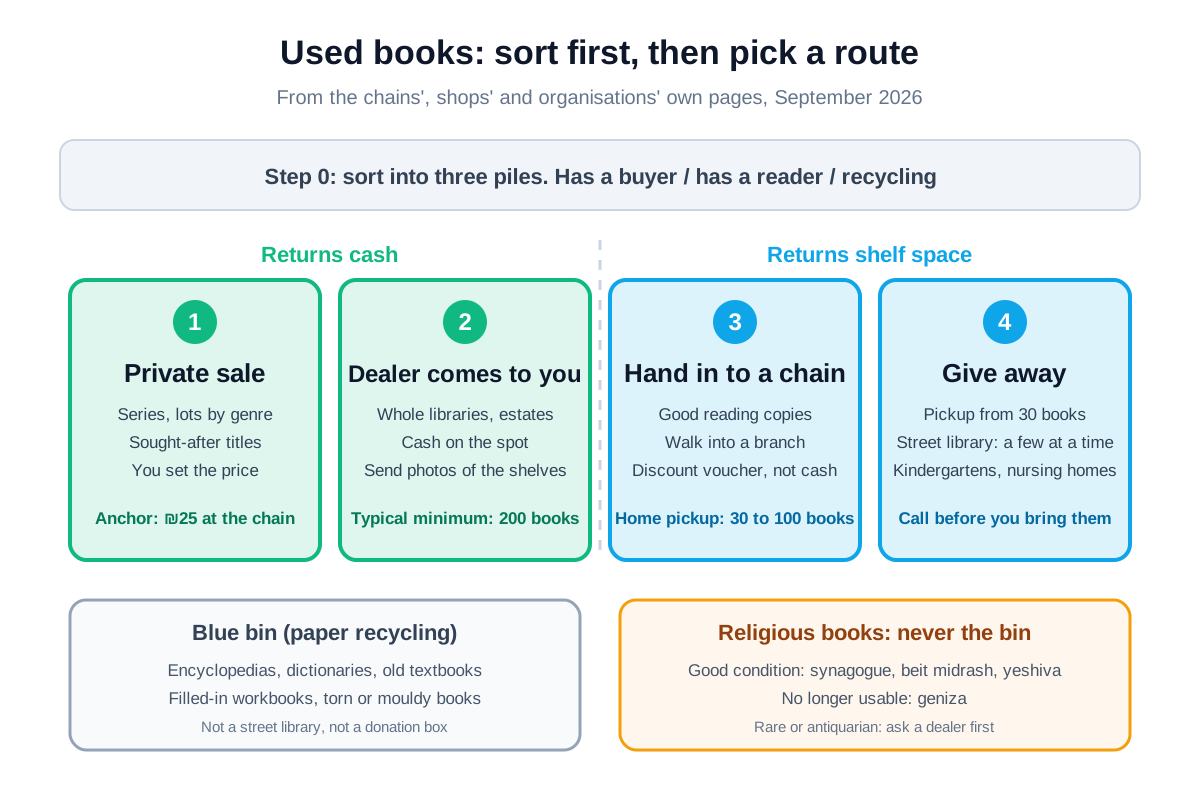
Sort first: what is in demand, and what will not sell anywhere
The chains and shops say it themselves, and their acceptance list is your list. In demand: Israeli and world fiction, thrillers, children's and young-adult books in good condition, current non-fiction, and books in English (particularly wanted by second-hand shops and academic libraries). Books by well-known authors, Sipur Hozer writes, are snapped up from street libraries and shops within days. A complete series is worth more than the sum of its parts, and a set like that should stay together. Not in demand, and not accepted as a donation in most places either: encyclopedias and dictionaries (the information is online), textbooks from superseded editions, and any book that is torn, stained or shows mould. These go in the blue paper-recycling bin, not in a street library and not in a donation box, because sorting at the receiving end costs money and these books end up in the rubbish anyway. Religious books are a category of their own: most general organisations do not accept them, and copies no longer fit for use go to geniza (ritual burial), not the bin. More on that below. The result of the sort is three piles: what has a buyer (routes one and two), what has a reader but no buyer (routes three and four), and what goes to recycling. Most home shelves split roughly that way, and whoever skips this step posts a listing that never moves.
Route 1: a private sale, and why a lot beats a single book
The only route where you set the price. It works well for books with known demand: complete series, out-of-print titles, first editions, textbooks in the current edition, and professional non-fiction. The rule that separates a listing that sells from one that gathers dust: a single ordinary book is not worth the buyer's trip. Someone who wants one novel for ₪20 will find it at a second-hand chain a shopping centre away and will not drive to you. So ordinary reading copies go as lots: "12 translated thrillers", "the complete Harry Potter series", "20 children's books for ages 4 to 8". The lot gives the buyer a reason to come, and gives you an empty shelf in one go. A single book belongs in a private sale only when it is itself the reason: a title someone searches for by name. Then the listing title carries the book's name, the author, the publisher and the edition year, because that is how it is searched for. Where: on Shukshuk you list books and lots free through the chat, with no commission, and enquiries come straight to you. There are also dedicated book boards; the listing is built the same way on all of them, so the work is done once.
Route 2: a dealer who comes to the house, for a whole library
With hundreds of books (an estate, a flat being cleared, a professional library) the private route is impractical, and this is where book dealers who buy at the home and pay on the spot come in. - Intellect (30 Yafo Street, Jerusalem) state it explicitly: they buy from 200 books upwards, "fair payment, in cash", and travel anywhere in the country. The genres they name: history, philosophy, Judaism, the Land of Israel, law, art, science fiction and fantasy. They ask for clear photos of the shelves before a visit, and also buy CDs, records and art objects. - Green Brothers (39 Rabbi Yedidya Frankel Street, Tel Aviv, since August 2024) call themselves "book hunters": they buy used, rare and antiquarian books, and buy estates from the client's home. Open Sunday to Thursday 10:00 to 19:00 and Friday 9:00 to 16:00, and they refer rare items to auction. What to expect: a dealer buys in order to sell, so they pay for what they can sell, and a library of 300 books does not fetch 300 shelf prices. If a few titles in the library are ones you know to be rare, sell those separately first (route 1) and bring the dealer for the rest. We do not state what dealers pay, because no dealer publishes it, and a number someone said on the phone is not data.
Route 3: handing in to a second-hand chain, for a discount
Sipur Hozer is a chain of second-hand bookshops run by the "Shekulo Tov" group, a social enterprise that trains and employs people with disabilities. Every book in the chain sells at a uniform ₪25, in the branches and online, and the branch list on its website shows more than 20 branches, from Nahariya and Akko down to Beer Sheva and Netivot. How it works: walk into any branch without an appointment and hand in books in good condition; for every book handed in you receive a discount voucher for your next purchase at the chain. It is not cash. This is the route for someone who wants the books to go on being read without dealing with listings, and for anyone who buys books anyway. For large quantities you can arrange a free home pickup; by their own guide, most chains require a minimum of 30 to 100 books for a pickup, and ask for sturdy boxes of up to 25 books each, with an accurate count given when booking. What happens to the books: they are sorted; copies in good condition are sold in the shops or passed to libraries, and less-wanted ones go to street libraries or paper recycling. The chain also maintains the street libraries at railway stations.
Route 4: giving them away, with a pickup or without
For anyone who just wants the shelf cleared and the books in someone's hands, a few addresses genuinely take them. - Am HaSefer (Ramat HaSharon) collect free from the home from 30 books upwards: reading and non-fiction books in Hebrew in good condition, and not dictionaries, encyclopedias, religious books or school textbooks. Some of the books they place in street libraries in Beer Sheva, and some are sold on their site. - Street libraries: a small one holds about 200 books, so give a few at a time rather than leaving a whole box on the pavement. No religious books, dictionaries, encyclopedias or textbooks in them. - Kindergartens and schools want children's books in new or near-new condition; nursing homes and pensioners' clubs take adult books; hospitals run small libraries for patients; public and community libraries accept donations, but call first to check there is room and the books suit the collection. Most of these do not collect, so you bring them. - A "free" listing on Shukshuk: post "20 children's books, free" with a photo, and whoever wants them comes and takes them. It is the fastest route for a lot that did not sell, and it usually goes within days. Before handing over, on any route: wipe off the dust, check no pages are missing, and take out bookmarks and personal notes left between the pages.
Pricing: no price list, one anchor
There is no price table for used books, and anyone looking for one finds only other people's listings. But there is an anchor every buyer in Israel knows: a second-hand chain sells every book at ₪25, and what is not there is usually at another chain nearby. The method follows from that. 1. An ordinary reading copy in good condition that the chain could have: its private price is below ₪25, because the buyer needs a reason to prefer you over a shop with returns and opening hours. That is why such books go as a lot, at a price for the lot, not per book. 2. A book the chain cannot supply (out of print, first edition, a complete series, a professional title, signed): open a board and search for the same title. Three to five listings of the same book give a range; your copy's condition relative to them decides where in the range. If there is no listing at all, that does not mean it is valuable; sometimes it means it has no buyers. 3. A textbook: its value comes from the edition, not the condition. An edition no longer on the school's list is worth recycling, not selling. Details in the next section. 4. The real test comes after posting: two weeks without an enquiry on a lot means the price is wrong or the lot is uninteresting, not that "nobody saw it". Cut once, clearly, or add books to the lot. A convention worth adopting from the dedicated boards: when a single book is sold by post, write "price includes shipping" in the title, because a buyer of a ₪40 book does not want to discover another ₪26 in the second message.
Textbooks and religious books: two cases with rules of their own
Textbooks. This market is smaller than it looks, and there is a reason: most schools run a textbook lending scheme in which parents pay a participation fee (by Kol Zchut, updated 7.9.2026, the cap is ₪280 per pupil in primary and middle school and ₪320 in high school), receive the books on loan, and return them at the end of the year. Families in the scheme do not buy used textbooks. The buyers are families outside it, and one thing matters to them: the edition on the school's list for this year. So: photograph the edition page, put the publication year in the title, list from June to September, and recycle editions that have been replaced. Filled-in workbooks are worth nothing, even in pencil. Religious books. Prayer books, Pentateuchs, books of Psalms and any book carrying the name of God are not thrown in the bin and not left in a street library; when no longer fit for use they go to geniza, and most general organisations do not accept them as donations. Copies in good condition go to a synagogue, a beit midrash or a yeshiva nearby, where they are accepted; rare or antiquarian religious books are exactly what the dealers in route 2 look for, and are worth asking about before burial.
The listing, the post and the handover
The listing. One photo of the whole lot arranged spines out, so the titles can be read, and one of the covers of three or four of the standout books. For a single book: front cover, back, the title page (where the edition shows), and any defect. In the text: how many books, which titles (a list, not "and more"), language, condition in plain words ("read once", "paperback with creases on the spine", "stamp of a previous library"), city, and whether the price includes shipping. A lot sells on the list inside it, so the list is the listing. By post. Under the Israel Post tariff update that took effect in February 2024 (the latest complete table we found from a press source, checked on 15.9.2026): a domestic parcel from branch to branch costs ₪26 up to 2 kg, ₪32 up to 5 kg and ₪37 up to 10 kg, with ₪3 off for preparing the shipment at home through the "Doar BeClick" service; a registered envelope costs ₪19 up to 200 g and ₪21 up to 500 g. One paperback fits a registered envelope, three or four books a parcel up to 2 kg. The tariff changes, so check the price calculator on the Israel Post site before writing "includes shipping". Wrap the book in a plastic bag inside the envelope: a book that gets wet on the way is a book that comes back. Hand to hand. For lots and series this is the way: the buyer comes, looks, takes. Meet in a public place or at the building entrance, cash or an instant transfer while you watch, and never send a lot before the payment has landed.
FAQ
How much is a used book worth?
There is no price list. The anchor is ₪25, the uniform price of every book at the Sipur Hozer chain: an ordinary reading copy that the chain could have sells privately for less, and so goes as a lot; a book the chain cannot supply (out of print, first edition, a complete series, professional) is priced from three to five listings of the same title on the boards.
Where can I sell used books for cash?
Two routes: a private sale on a board (for example free on Shukshuk), which suits series, lots and sought-after titles; or a sale to a book dealer who comes to the home, which suits whole libraries. Intellect in Jerusalem buy from 200 books up in cash and travel nationwide; Green Brothers in Tel Aviv buy estates from the home. The second-hand chains give a discount voucher, not cash.
Does Sipur Hozer buy books?
Not for cash. You hand in books in good condition at any branch without an appointment, and for every book you receive a discount voucher for your next purchase at the chain. For large quantities you can arrange a free home pickup; by their guide, the usual minimum for a pickup is 30 to 100 books.
Which books are not worth trying to sell or donate?
Encyclopedias and dictionaries, textbooks from replaced editions, filled-in workbooks, and any book that is torn, stained or mouldy. These go in the blue paper-recycling bin. Religious books no longer fit for use go to geniza, not the bin and not a street library.
Where can I donate books with a home pickup?
Am HaSefer collect free from 30 books upwards (Hebrew reading and non-fiction in good condition, no religious books, dictionaries, encyclopedias or textbooks). The second-hand chains arrange pickups for large quantities. Kindergartens, schools, nursing homes and libraries mostly accept only if you bring the books, and you call first.
How much does it cost to post a book?
Under the Israel Post tariff update of February 2024: a registered envelope is ₪19 up to 200 g and ₪21 up to 500 g (one paperback), and a branch-to-branch parcel is ₪26 up to 2 kg (three or four books), with ₪3 off when prepared at home. The tariff changes; check the calculator on the Israel Post site before promising "includes shipping".
How do I sell used textbooks?
Only in the edition on the school's list for the current year, because most schools run a lending scheme (participation fee capped at ₪280 in primary and middle school and ₪320 in high school, by Kol Zchut) and families in it do not buy. Photograph the edition page, put the publication year in the title, and list from June to September.
Sources
- Sipur Hozer, how to hand in old books properly (what is accepted, home pickup, street libraries; Hebrew)
- Sipur Hozer, about (uniform ₪25 price, discount voucher per book handed in; Hebrew)
- Sipur Hozer, branch list (Hebrew)
- Intellect Books, we buy books (from 200 books, cash, nationwide; Hebrew)
- Green Brothers, about (estate purchases from the home, address and hours; Hebrew)
- Am HaSefer, giving books for free (pickup from 30 books; Hebrew)
- Yosefus, clearing books for donation: places that accept books (Hebrew)
- Kol Zchut, textbook lending scheme (participation-fee cap, updated 7.9.2026; Hebrew)
- Mako, Israel Post tariffs from February 2024 (domestic parcels and registered mail; Hebrew)

See also
The details about the chains, shops and organisations were read from their own websites on 15.9.2026 and may change; confirm with them before travelling or booking a pickup. Postal tariffs are quoted from the February 2024 update and change from time to time. This guide is not a valuation of any particular book.