How to Sell Paintings in Israel: Where to Sell, What You Keep, What to Know First
Shukshuk team · Updated November 2026
A painting can be sold in five main ways: directly to the buyer (a listing, an open studio, a fair), through Instagram, on an international art site, through a gallery, or at auction. The difference is who brings the buyer and what you keep: in a direct sale the whole price is yours and so is all the work, while sites and galleries bring buyers and take part of the price. This guide goes through each channel with the numbers the sites themselves publish, explains how to photograph and describe a painting so that someone will buy it unseen, and sums up the two things that come up at every sale: tax and copyright. The figures were read on 27.11.2026.
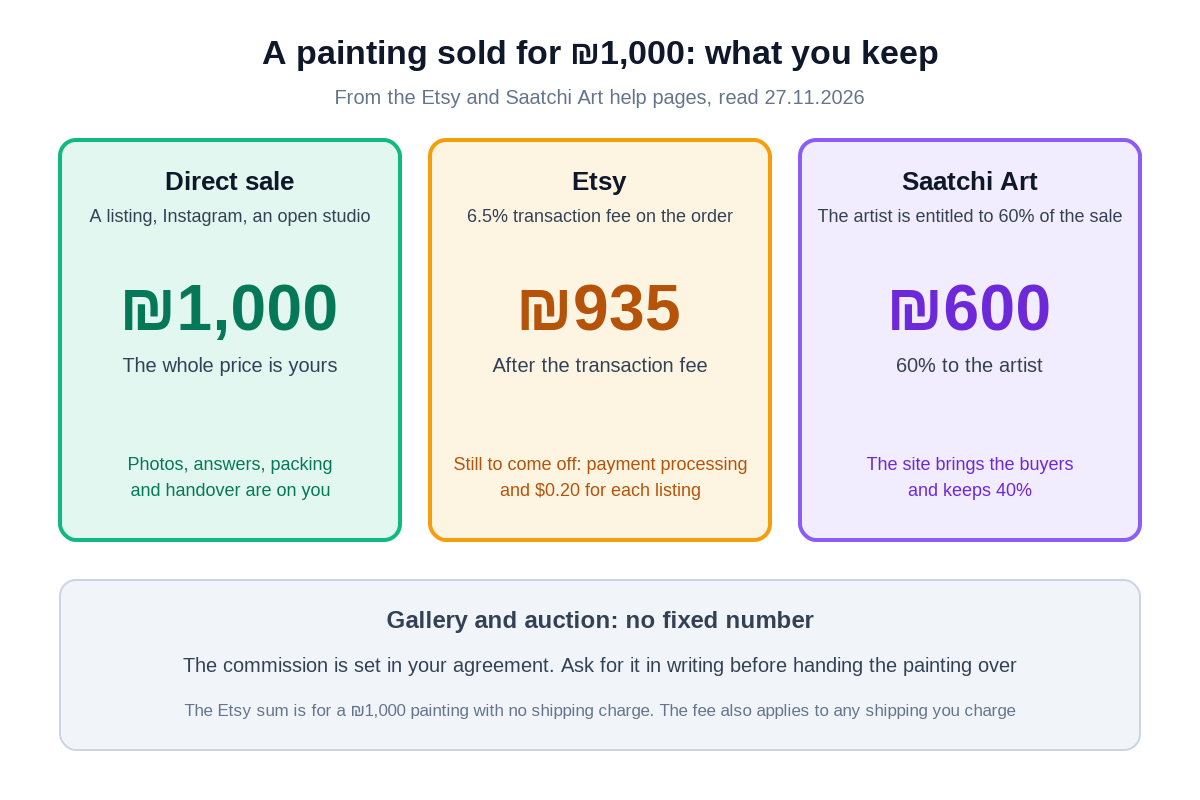
Where to sell paintings, and what each channel takes (read 27.11.2026)
- Who brings the buyer
- You
- What it costs you
- Nothing off the price. A Shukshuk listing is free; a fair usually charges for the stall
- Who brings the buyer
- You, through your followers
- What it costs you
- Nothing off the price when the sale closes in a direct message and the buyer pays you directly
- Who brings the buyer
- The site
- What it costs you
- The artist receives 60% of the sale amount
- Who brings the buyer
- The site, and you
- What it costs you
- 6.5% of the order total including shipping, $0.20 per listing even if it does not sell, plus a payment processing fee
- Who brings the buyer
- The gallery
- What it costs you
- A commission on the price, set in your agreement with the gallery. There is no standard rate
- Who brings the buyer
- The auction house
- What it costs you
- A seller commission, set in the consignment agreement. Ask for it in writing before you hand the painting over
| Channel | Who brings the buyer | What it costs you |
|---|---|---|
| Direct sale: a listing, an open studio, a fair | You | Nothing off the price. A Shukshuk listing is free; a fair usually charges for the stall |
| You, through your followers | Nothing off the price when the sale closes in a direct message and the buyer pays you directly | |
| Saatchi Art (international site for original art) | The site | The artist receives 60% of the sale amount |
| Etsy (international site for crafts and handmade work) | The site, and you | 6.5% of the order total including shipping, $0.20 per listing even if it does not sell, plus a payment processing fee |
| Gallery | The gallery | A commission on the price, set in your agreement with the gallery. There is no standard rate |
| Auction | The auction house | A seller commission, set in the consignment agreement. Ask for it in writing before you hand the painting over |
The Saatchi Art and Etsy percentages come from the sites' own help pages. We found no gallery or auction house in Israel that publishes a fixed commission, so no number appears here: what counts is the agreement you are given.
Direct sale: a listing, an open studio, a fair
The simplest way, and the only one in which the whole price stays with you. The buyer sees the painting, talks to you and comes to collect it. A listing. It suits paintings at a price people pay for something for the home: a landscape, flowers, an abstract in colours that fit a living room. Someone looking for a painting for a wall searches by size, colours and city, so those details must be in the listing. On Shukshuk you list a painting free, in the chat or through the form, and buyers contact you directly. Open studios and artists' weekends. Many cities and neighbourhoods hold days when artists open their studio or home to the public. Buyers there came to see art, and they meet you, which is what sells a painting. Fairs and markets. At an artists' fair or a designers' market you usually pay for the stall, not a percentage of sales. Before signing up, ask what the stall costs, what it includes and who the crowd is. What falls on you: the photos, the description, answering questions, the packing and the handover.
How to sell paintings on Instagram
Instagram is a shop window, not a till. Most sales close in a direct message and the buyer pays you directly, so nothing comes off the price. 1. A profile that says what you sell: your name, what you paint, your city, and how to buy ("to buy: send a message"). 2. Every painting for sale gets its own post with the same details each time: medium, size in centimetres, framed or not, the price or "price by message", and whether it is still available. 3. Show the painting at its real size: hanging on a wall, next to a sofa or in your hands. A screen cannot tell 20 centimetres from a metre. 4. Show the work: a short video of a painting in progress draws more than a picture of the result, and it is also the proof that the painting is yours. 5. When a painting sells, update the post ("sold"). It tidies the enquiries and shows that people buy from you. 6. Decide in advance how payment works and how the painting travels (collection or delivery, and who pays for it), and write it to the buyer before they pay. The same painting can appear on Instagram and in a listing: on Instagram it is seen by people who already follow you, and in a listing by people who are looking for a painting and do not know you.
International sites: Saatchi Art and Etsy
Two large sites that bring buyers from abroad, with two different models. Saatchi Art. A site for original art. According to its support page, the artist is entitled to 60% of the sale amount: on a work sold for $1,000 (excluding shipping) the artist receives $600. Etsy. A site for crafts and handmade work, where paintings and prints are sold too. According to its fees page: $0.20 for each listing, whether or not it sells, and 6.5% of the order total, including shipping and gift wrap if you charge for them. Each transaction also carries a payment processing fee, which differs by country. What to know before you sign up: you will be shipping a painting abroad, so find out what a parcel of that size costs to send and pack it to survive the trip. And the price of a painting should be the same everywhere: a buyer who finds the same painting cheaper on your Instagram will not buy it on the site.
A gallery and an auction
A gallery. The gallery shows the work, brings buyers and sells, and takes a commission on the price. There is no standard rate and we found no gallery that publishes its commission, so what counts is the agreement. Before leaving a painting with a gallery, ask in writing: the commission percentage, who sets the price and who may give a discount, how long the painting stays, who is responsible if it is damaged, and how soon after a sale you are paid. An auction. It suits mainly paintings by artists who already have a market, including a painting you inherited or bought. The auction house values the painting, agrees an opening price with you and charges a seller commission on the price it fetches. Here too there is no standard number: ask for the commission and the other costs (photography, catalogue, insurance) in writing before handing the painting over, and ask what happens if it does not sell. An old painting whose painter you do not know: before selling, photograph the signature and the back, and send the photos to an auction house or a valuer with one question: who painted it, and is it worth bringing in to be looked at.
How to photograph and describe a painting for sale
The buyer cannot touch the painting, so the photos and the description do all the work. The photos: 1. Straight on from the front, in daylight near a window and without flash, so there is no glare on the paint and no skewed angles. 2. A close-up that shows the brushstrokes and the texture. 3. A side view that shows the depth of the canvas or the frame. 4. The signature. 5. The back of the painting. 6. The painting hanging on a wall or next to furniture, so the size is clear. The description: Medium and support (oil on canvas, acrylic on wood, watercolour on paper), size in centimetres, width by height, the year, signed or not, framed or not, and whether it is ready to hang. Original or print. If it is a print, say so in words, and how many copies exist. A buyer who discovers they paid an original's price for a print will ask for their money back, and rightly. Condition, if the painting is not new: cracks, fading, stains. Your city, and whether delivery is possible.
How to set a price
There is no price list for art, and we will not invent one. What you can do: Start from the cost. Canvas, paint, a frame, and your hours. A price that does not cover the materials is a loss on every sale. Be consistent. Many artists price by size, so that two paintings of the same size and medium cost the same. A buyer who sees two similar paintings at very different prices asks why. Look at what sold. Not what is asked but what sold: paintings by artists at a stage similar to yours, in the same size and medium. A post marked "sold" and a listing that came down say more than a price that has hung for six months. Remember the commission. If you sell both on a site that takes 40% and directly, the buyer's price should be the same in both places, so set it so that the sum left after the commission is one you are content with. Raise it gradually. It is easier to raise a price after a few sales than to lower it.
Tax: when you need to register as a dealer
Someone who sells paintings regularly is running a business, and a business is registered with the tax authorities. The status most artists starting out look at is the VAT-exempt dealer (osek patur): according to Kol Zchut, a business whose annual turnover (turnover, not profit) does not exceed ₪122,833 in 2026 may register as exempt. An exempt dealer does not charge buyers VAT, but still reports to income tax and National Insurance. This is general information and not tax advice. How to register, what to report, and how a one-off sale of a painting is treated are questions for an accountant or a tax adviser, before the sale and not after it.
Copyright: what the buyer gets and what stays with you
Under the Israeli Copyright Law, 5768-2007: The creator is the first owner of the copyright in a work (section 33). This holds for a commissioned painting too, unless the commissioner and the creator agreed otherwise (section 35). A contract transferring copyright requires a written document (section 37). So whoever bought a painting bought the painting itself. For them to print it on posters or products as well, a written agreement must transfer the right to them or grant a licence. Copyright lasts for the life of the creator and seventy years after their death (section 38). The moral right, meaning the right to be named on the work and not to have it distorted, is personal and cannot be transferred, and it stays with you even if you transferred the copyright (sections 45 and 46). In practice: write to the buyer, in a message or on the receipt, what they are buying ("the original painting, without reproduction rights"). And if someone asks to use your painting for a product, a book or an advertisement, that is a separate agreement, in writing.
FAQ
Where is the best place to sell paintings?
It depends on who is meant to bring the buyer. In a direct sale (a listing, an open studio, a fair) and on Instagram the whole price stays with you and you do all the work. Saatchi Art brings buyers from abroad and leaves the artist 60% of the sale amount. Etsy charges 6.5% of the order plus $0.20 a listing. At a gallery or an auction the commission is set in the agreement.
How do you sell paintings on Instagram?
A profile that says what you paint and how to buy, a post for each painting with the medium, the size in centimetres and the price, a picture that shows the real size on a wall, and a "sold" mark when a painting sells. The sale itself closes in a direct message and the buyer pays you directly.
How much do Saatchi Art and Etsy take?
According to their help pages, read on 27.11.2026: on Saatchi Art the artist is entitled to 60% of the sale amount, so the site keeps 40%. Etsy charges $0.20 for each listing, 6.5% of the order total including shipping, plus a payment processing fee.
Can someone who bought my painting print it on products?
Not without an agreement. Under the Israeli Copyright Law the creator is the first owner of the copyright, and a contract transferring it requires a written document. Selling the painting itself does not transfer the right to reproduce it.
Do I need to register as a dealer to sell paintings in Israel?
Someone who sells regularly is running a business, and a business is registered with the tax authorities. A VAT-exempt dealer (osek patur) is one whose annual business turnover does not exceed ₪122,833 in 2026, according to Kol Zchut. For your own case, and for a one-off sale, ask an accountant or a tax adviser.
Sources

See also
The Saatchi Art and Etsy fees and the VAT-exempt ceiling were read at the sources on 27.11.2026 and may change. This guide is general information and is not tax or legal advice. Shukshuk is not affiliated with the sites named here.