How to Rent Out an Apartment in Israel Without a Broker: Pricing, Listing, Tenant Screening, Deposits and Tax
Shukshuk team · Updated September 2026
Renting out an apartment without a broker is not complicated, but it has an order, and whoever skips a step finds out in month three: a tenant who does not pay, a deposit that was never allowed, a municipal tax bill that keeps arriving in your name, or a letter from the Tax Authority. This guide follows the landlord's order: how much to ask, what the apartment must include under the Fair Rental amendment, what goes in the listing, how to check a tenant without building a file on them, how much security is allowed, what the contract must state and who pays for what, which tax track to pick, and what a handover that never comes back to you looks like. At the end you have a priced, photographed apartment ready to list.
Eight steps, from the price to the key
- What you do
- 5 to 10 similar listings on the same street and size
- The number to remember
- No price list; a week with no calls = wrong price
- What you do
- Drainage, water, electricity and lighting, windows and a lockable door
- The number to remember
- First Schedule to the law, section 25ו
- What you do
- Rooms, m², floor and lift, parking, move-in date, what is included
- The number to remember
- List on Shukshuk free, no commission
- What you do
- Call, viewing, pay slips and employer letter only from the one you choose
- The number to remember
- Do not collect documents from everyone who asks
- What you do
- Cash deposit or bank guarantee capped by law
- The number to remember
- The lower of 3 months' rent or a third of the term's rent
- What you do
- Written, signed, copy to the tenant, known defects listed
- The number to remember
- Repairs: within 30 days; urgent: within 3 days
- What you do
- Exemption, 10% or marginal track
- The number to remember
- 2026 exemption ceiling: ₪5,654 a month
- What you do
- Meter and photo protocol, tenant registered for arnona
- The number to remember
- Lease of 12 months or more; until written notice, the registered holder pays
| Step | What you do | The number to remember |
|---|---|---|
| Pricing | 5 to 10 similar listings on the same street and size | No price list; a week with no calls = wrong price |
| The apartment | Drainage, water, electricity and lighting, windows and a lockable door | First Schedule to the law, section 25ו |
| The listing | Rooms, m², floor and lift, parking, move-in date, what is included | List on Shukshuk free, no commission |
| Screening | Call, viewing, pay slips and employer letter only from the one you choose | Do not collect documents from everyone who asks |
| Security | Cash deposit or bank guarantee capped by law | The lower of 3 months' rent or a third of the term's rent |
| Contract | Written, signed, copy to the tenant, known defects listed | Repairs: within 30 days; urgent: within 3 days |
| Tax | Exemption, 10% or marginal track | 2026 exemption ceiling: ₪5,654 a month |
| Handover | Meter and photo protocol, tenant registered for arnona | Lease of 12 months or more; until written notice, the registered holder pays |
Every number in the table was checked on 14.9.2026 against Kol Zchut, the law text on Nevo and a municipal page; sources at the bottom of the page.
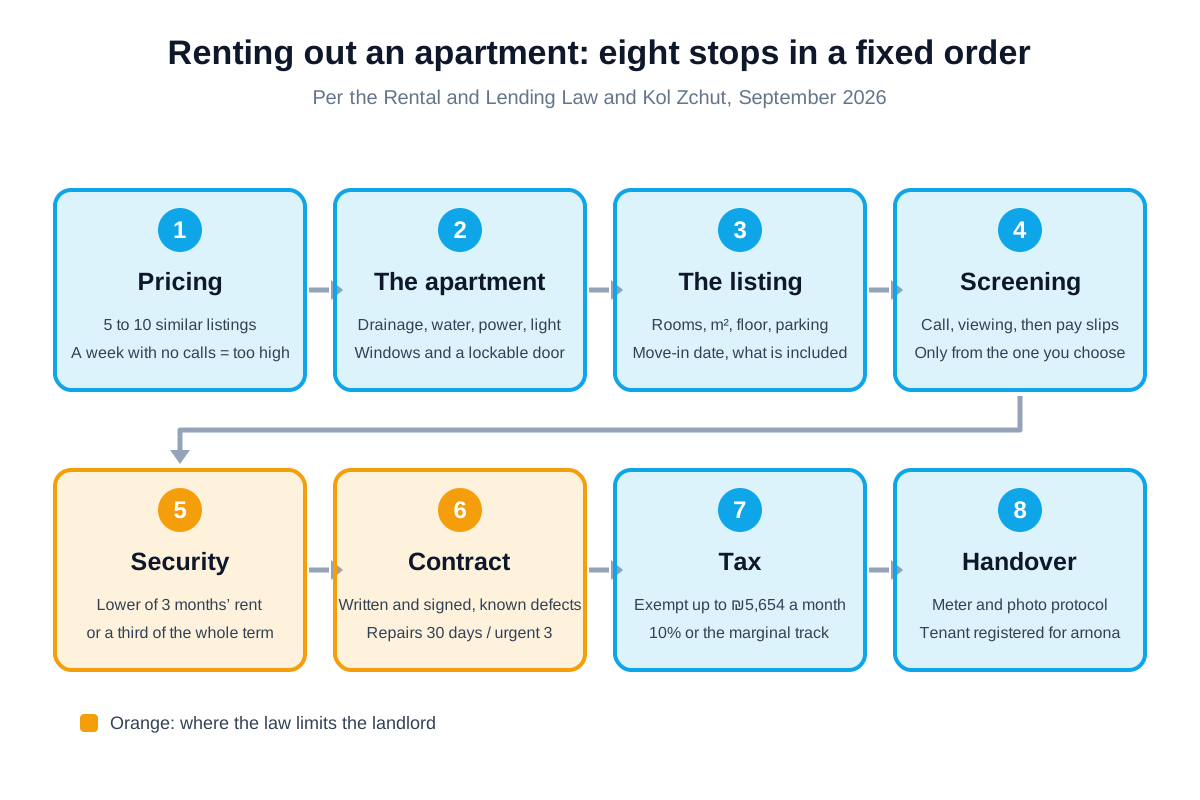
How much to ask: the method, because there is no price list
There is no official rent table by city, and a number someone tells you on the phone is not data. What there is, is the market itself, and it is open to everyone. 1. Open the boards and look for rentals on the same street or neighbourhood, with the same number of rooms, roughly the same area, and the same two things that move price more than anything else: a lift and parking. Five to ten listings are enough. 2. Mark what your apartment has over them (balcony, air conditioning in every room, a fresh renovation, orientation) and what it lacks (a high floor with no lift, the neighbour's yard under the window). That moves the price within the range you found, not outside it. 3. The rent you need to cover the mortgage is not the tenant's concern. If the market range is lower than you hoped, that is the answer. 4. The real test comes after posting: a week without serious enquiries means the price is wrong, not that the listing was not seen. One clear cut beats three small ones. What not to do: price high "to leave room to negotiate". Tenants in Israel filter by price before they open the listing, and the apartment simply will not be opened.
What the apartment must include by law
The Rental and Lending Law (the amendment known as the "Fair Rental Law") states in section 25ו that the landlord must hand over an apartment fit for living, and the First Schedule to the law says exactly what that means. An apartment is not fit for living if it lacks any of these: - a drainage system, including regular sewage disposal - a drinking-water supply - an electrical system or a lighting system - openings for ventilation and natural light, and doors and windows to close them, including a main entrance door that can be locked and also any apartment with an unreasonable safety or health hazard. It is a low bar, and most apartments clear it without thinking. The point for a landlord is different: do not write "the tenant accepts the apartment as is" in the contract and expect it to waive this list, because the provision is mandatory. Defects you know about (a dripping tap, a stuck shutter) do not make the apartment unfit, but the law requires them to be stated in the contract, and whoever writes them there saves the argument a year later about "who broke it". Before the photos: small repairs, a thorough clean, a bulb in every socket, and clearing out whatever does not stay. An apartment with the previous tenant's wardrobes photographs as occupied.
The listing: what to write and what to photograph
The questions every tenant asks in their first message should already be in the listing, because a listing that does not answer them gets those questions instead of a viewing: - rooms and area in m² (the apartment's area, not including the balcony; if the balcony is large, separately) - floor, whether there is a lift, whether there is parking (registered, in use, or on the street) - move-in date and the term you want, including an option - the rent, and whether the building fee is included or separate - what stays in the apartment: air conditioners (in how many rooms), kitchen, wardrobes, solar water heater - pets: yes or no, so nobody negotiates it with you at the viewing Photos: in daylight, after cleaning, every room from the corner that shows most of it, the kitchen and bathroom up close, and one photo of the view from the window. No photos with the previous tenants' belongings in the apartment, and no photo of the front door alone. Where: on Shukshuk you list an apartment for rent free through the chat, with no commission, and the enquiries come straight to you. The legal side of "without a broker" is worth knowing too: under section 25ט of the law, if you hire a broker, you pay their fee, and you may not pass it on to the tenant. A listing of your own removes that expense entirely.
Screening tenants without building a file on people
The right order is a funnel, not a form at the door. 1. A short phone call with everyone who enquires: who will live there (how many people), from when, for how long, and what they do. Someone who refuses to talk and only writes usually does not turn up to the viewing. 2. A viewing. You meet the people who will actually live there, not a representative. 3. Only for the one or two you are seriously considering: proof of income (the last three pay slips, or a report for the self-employed), an employment letter, and if you want, the previous landlord's number. Ask this of one or two people, not everyone who was interested; there is no reason to have twenty strangers' pay slips on your computer. 4. Agreement on the terms in conversation, and only then the contract. What you are actually checking: that the income covers the rent comfortably, that the story is consistent (the same employer on the phone and on the slip), and that the tenant is not in too much of a hurry. A tenant who wants to sign today and transfer a deposit before seeing the apartment is a warning sign, not luck. What not to do: do not decide by origin, religion, family status or country of birth, and do not ask about them. Legal question aside, it simply does not predict payment. A pay slip does.
Security: what you may ask for, and up to how much
Here the law limits you, and it is the point most landlords get wrong out of habit. Under section 25י of the law, security that costs the tenant money (a cash deposit, a bank guarantee, a guarantee from an insurance or credit company) is capped at the lower of two figures: three months' rent, or a third of the rent for the whole term. On a one-year contract at ₪5,000 a month, a third of the term is ₪20,000 and three months is ₪15,000, so the cap is ₪15,000. The cap does not apply to security that costs the tenant nothing: a security cheque, a promissory note, and personal guarantors. You may ask for those in addition, and most landlords ask for a promissory note with one or two guarantors. The cap applies when the conditions are met: a residential apartment, rent up to ₪20,000 a month, a term longer than three months (or with an option) and up to ten years, and parties who are not relatives. When you may draw on it: only for unpaid rent, unpaid running bills, damage the tenant is responsible for and did not repair, and a tenant who did not vacate. Not for reasonable wear. When you return it: within 60 days of the day the tenant left (or of the day the debts were settled, whichever is later), whatever was not drawn. A deposit sitting in your account a year after the move-out is a breach, not a custom.
The contract: what must be in it, and who pays for what
The contract must be in writing, signed by both of you, and a signed copy handed to the tenant. The law lists what it must include: the apartment's address, the parties' names and ID numbers, a description of the apartment and what stays in it, the term and options, the rent and payment dates, additional payments the tenant bears, and known defects. We have a neutral template with an explanation of every clause in the rental contract guide (links below). Who pays for what (section 25ט): the tenant bears the rent, arnona, water, electricity and gas, and the regular building fee. You bear the building insurance, the fee of a broker who acted for you, and the upgrade or replacement of fixed systems in the apartment (boiler, plumbing, electrical panel), unless the tenant asked for a change for themselves. A clause that shifts these onto the tenant is not valid, because the provision is mandatory. Repairs (section 25ח): a defect that is not trivial and was not caused by unreasonable use is yours to repair, within a reasonable time and no more than 30 days from the request. A defect that prevents reasonable living (no water, no electricity, a door that does not lock) is urgent: within 3 days. If you did not repair in time, the tenant may repair and demand reasonable costs back, or reduce the rent. It is worth writing in the contract who the contact for repairs is and how to notify, because the clock starts at the request. Worth adding beyond the requirement: an early-exit mechanism (notice and a reasonable replacement tenant), who looks after the garden or balcony, and a ban on subletting and short-term hosting without consent.
Tax on the rent: three tracks and one ceiling
An individual who rents a residential apartment to an individual (not to a business, not as part of a business) chooses one of three tracks each year. 1. Exemption. In 2026 the exemption ceiling is ₪5,654 a month, unchanged from 2025. If your total monthly rent (from all apartments together) does not exceed it, you are fully exempt and need do nothing. Above the ceiling and up to ₪11,308 a month there is a partial exemption: subtract from the ceiling the amount by which you exceeded it, and what remains is exempt; the rest is taxed at the marginal rates. Above ₪11,308 a month there is no exemption at all. 2. The 10% track. You pay 10% of the gross rent, with no expenses deducted (no repairs, no depreciation, no mortgage interest). It is paid once a year, within 30 days of the end of the tax year, so the tax on 2026 rent is paid by the end of January 2027. It is the simple track for a landlord whose rent is above the exemption ceiling and whose expenses are small. 3. The marginal track. The rent joins your regular income and is taxed by the brackets, but expenses may be deducted: repairs, depreciation, interest, management fees. Worthwhile when expenses are large, and it requires an annual return. The ceiling is updated every year and calculated per month, so an apartment rented for only part of the year is tested by the months it was rented. Anyone with more than one apartment, or torn between 10% and the marginal track, is better off with an hour of a tax adviser before January, not after it.
Handover: protocol, meters and arnona
The day you hand over the key is the day every future argument is decided, so do it with paper. Handover protocol: the date, the readings of the water, electricity and gas meters, a list of what stays in the apartment, photos of every room (including the defects already stated in the contract), the number of keys handed over, and both your signatures. The same protocol is opened again on move-out day, and the comparison between them is what decides whether any of the security is drawn. Arnona: as long as you have not notified the municipality in writing, you are the registered holder, and the arnona bill stays yours, even if the tenant lives there and pays you. On a lease of 12 months or more the tenant can be registered as the holder, and most municipalities require a complete, signed copy of the contract; on a lease shorter than 12 months the owner stays registered. Do it in the week of the handover, not when a debt notice arrives. Electricity, water and gas: transfer to the tenant's name using the meter readings in the protocol, so that your last bill and their first meet at the same number. From now on: a receipt for every payment (a bank transfer is preferable for exactly this reason), repairs on time, and a record of every request and its date. A landlord who keeps an orderly file almost never ends up in court, because there is nothing to argue about.
FAQ
How much deposit may I ask a tenant for?
Under section 25י of the Rental and Lending Law, a cash deposit or bank guarantee is capped at the lower of three months' rent or a third of the rent for the whole term, when the lease is for a residential apartment at up to ₪20,000 a month, for more than three months and up to ten years, and between people who are not relatives. A security cheque, a promissory note and personal guarantors are not capped and may be asked for in addition. The deposit is returned within 60 days of the move-out.
Do I have to pay tax on rental income?
It depends on the amount and the track. In 2026, an individual renting a residential apartment to an individual is fully exempt if their total monthly rent does not exceed ₪5,654; between that and ₪11,308 there is a partial exemption, and above it there is none. Anyone over the ceiling can choose the 10% track on gross rent (no expenses, paid within 30 days of the year's end) or the marginal track with expenses deducted.
Who pays the broker on a rental, the landlord or the tenant?
Each side pays the broker who acted for them. Under section 25ט of the law, a landlord may not require the tenant to pay the fee of a broker the landlord hired. Whoever lists the apartment themselves, for example free on Shukshuk, pays no brokerage at all.
What must a rental contract include?
The contract must be written and signed, with a copy handed to the tenant. It must include the apartment's address, the parties' names and ID numbers, a description of the apartment and what stays in it, the term and options, the rent and payment dates, additional payments the tenant bears, and known defects. A template with an explanation of every clause is in our rental contract guide.
How quickly must a landlord repair a fault?
A defect that is not trivial and was not caused by unreasonable use: within a reasonable time and no more than 30 days from the tenant's request. A defect that prevents reasonable living in the apartment: within 3 days. If the landlord did not repair in time, the tenant may repair and demand reasonable costs back, or reduce the rent accordingly.
How do I transfer the arnona to the tenant's name?
On a lease of 12 months or more, apply to the municipality with a complete, signed copy of the contract and ask to register the tenant as the holder. Until written notice is given, the registered holder, meaning you, is liable for the arnona. On a lease shorter than 12 months the owner stays registered and the tenant pays them.
Sources
- Kol Zchut, tax exemption on residential rental income (2026 ceiling, Hebrew, updated 22.2.2026)
- Kol Zchut, the cap on security a landlord may demand (Hebrew, updated 12.8.2026)
- Kol Zchut, repairing defects in a rented apartment (Hebrew)
- Kol Zchut, payments that may not be imposed on a tenant (Hebrew)
- Nevo, the Rental and Lending Law 1971 (sections 25ב to 25טו and the First Schedule, Hebrew)
- Bat Yam municipality, changing the registered holder of a property (arnona, Hebrew)
- Ziv Vardi & Co. CPAs, filings and payments due by the end of January 2026 (10% track deadline, Hebrew)

See also
This guide explains the rules under the Rental and Lending Law and the Tax Authority's provisions as read on 14.9.2026 from Kol Zchut, the law text on Nevo and the other sources listed below; it is not legal or tax advice. The exemption ceiling is updated every year. With more than one apartment, a corporate tenant, or doubt between the tax tracks, consult a tax adviser or a lawyer.