What Does a Nanny Cost in Israel? Hourly, Monthly and Night Rates, Plus Elder Carers
Shukshuk team · Updated October 2026
The Hebrew word "מטפלת" covers two completely different jobs, and searches mix them freely: a carer for a baby, and a carer for an elderly person. The prices differ several times over, the law differs, and public support exists for only one of them. This guide separates them, gives real ranges for each, and starts with a number that is not a market rate but a legal one: the minimum wage. Some of the rates circulating for this work are below it, and paying them is a criminal offence.
Carer cost ranges in Israel, as of October 2026
- Cost
- ₪40 to ₪60
- Note
- Usually above ₪50 in the centre
- Cost
- ₪50 to ₪80
- Note
- Cost
- ₪7,280 to ₪9,100
- Note
- 182 hours at ₪40 to ₪50, before National Insurance
- Cost
- ₪800 to ₪1,300 a night
- Note
- Per N12, November 2025
- Cost
- 6.05% of wages
- Note
- Employer share from age 18, from 1.1.2026
- Cost
- ₪60 to ₪110
- Note
- Includes the agency's employer costs
- Cost
- ₪7,000 to ₪12,000
- Note
- About 4 to 6 hours a day
- Cost
- About ₪7,500 in year one
- Note
- About ₪8,700 from year two, all in
- Cost
- 10 to 30 hours
- Note
- Levels 2 to 6, paid by National Insurance
- Cost
- ₪35.40 per hour
- Note
- Minimum wage from 1.4.2026, not a range
| Type | Cost | Note |
|---|---|---|
| Babysitter per hour, one child | ₪40 to ₪60 | Usually above ₪50 in the centre |
| Babysitter per hour, two or more | ₪50 to ₪80 | |
| Full-time nanny, per month | ₪7,280 to ₪9,100 | 182 hours at ₪40 to ₪50, before National Insurance |
| Night nanny for a baby | ₪800 to ₪1,300 a night | Per N12, November 2025 |
| National Insurance on a home carer | 6.05% of wages | Employer share from age 18, from 1.1.2026 |
| Elder carer via an agency, per hour | ₪60 to ₪110 | Includes the agency's employer costs |
| Part-time elder carer, per month | ₪7,000 to ₪12,000 | About 4 to 6 hours a day |
| Live-in foreign carer, per month | About ₪7,500 in year one | About ₪8,700 from year two, all in |
| Long-term care benefit hours per week | 10 to 30 hours | Levels 2 to 6, paid by National Insurance |
| The legal floor | ₪35.40 per hour | Minimum wage from 1.4.2026, not a range |
The live-in figure includes wages, national insurance, health insurance, pension and severance, which is why it looks higher than the wage itself. The long-term care benefit covers part of elder care, never childcare.
First: the minimum wage is not a suggestion
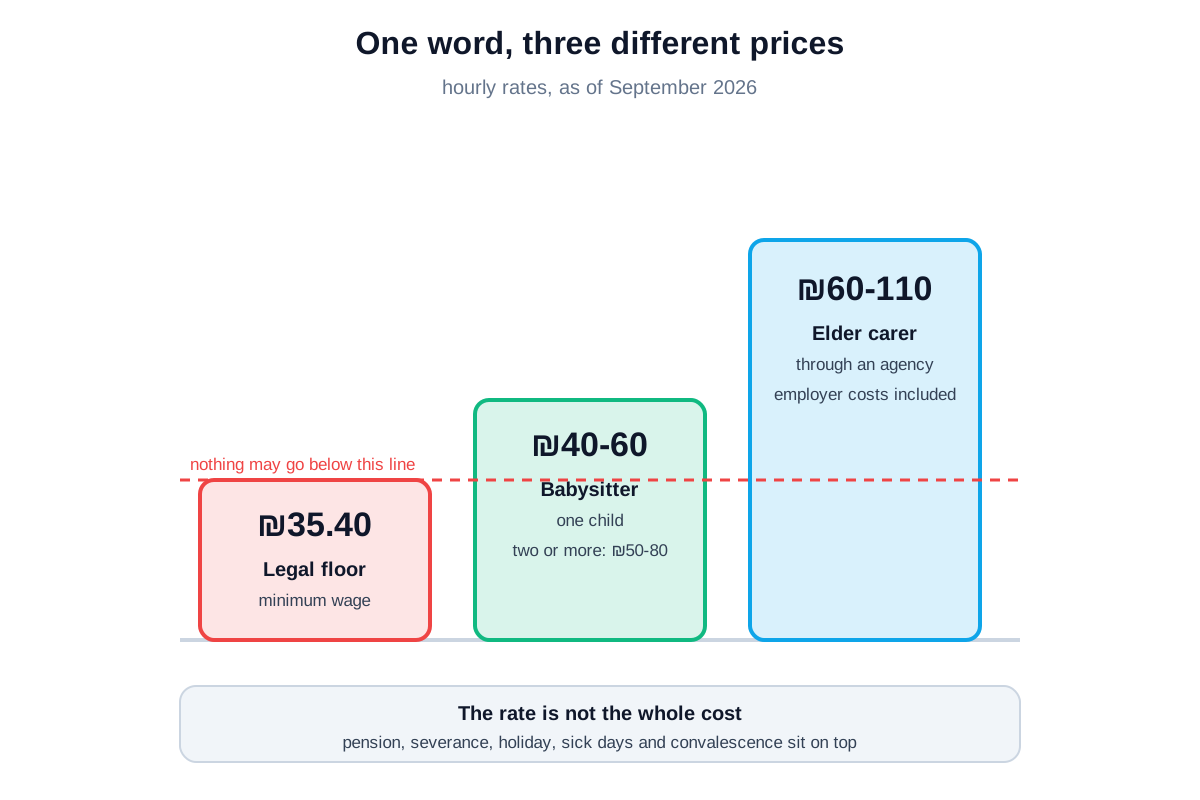
From 1 April 2026 the minimum wage in Israel is ₪35.40 per hour and ₪6,443.85 per month for a full-time post, under the Minimum Wage Law 5747-1987, which defines it as 47.5 percent of the average wage. Failing to pay it is a criminal offence, not a negotiating position. Why that opens a guide about prices: some of the figures circulating for this job sit below that floor. "₪30 an hour in the periphery" and "₪2,000 to ₪5,000 a month full time" both appear in Israeli sources, and for genuine full-time work they are simply unlawful: ₪2,000 a month is about a third of the legal minimum. Usually the explanation is that those numbers describe very part-time work, or undeclared work. If you are the employer, that distinction is yours to carry. And the point most people miss: the wage is not the whole cost. A regularly employed carer is also entitled to pension, severance, holiday, sick days and convalescence pay. A quoted hourly rate does not include them.
Childcare: by the hour and by the month
Two separate models, best not conflated: An hourly babysitter, for an evening or a few hours: about ₪40 to ₪60 an hour for one child, and about ₪50 to ₪80 for two or more, as of September 2026. In the centre, and Tel Aviv and Ramat Gan especially, rates are usually above ₪50; in the periphery they run lower, though never below the legal floor. A regular nanny, by the month: Israeli sources diverge sharply, from ₪2,000 to ₪5,000 up to ₪5,000 to ₪10,000, because they describe completely different hours and sometimes undeclared work. So do the sum yourself. A full-time post is 182 hours a month, the same base the minimum wage is calculated on (₪6,443.85 divided by ₪35.40). At ₪40 an hour that is ₪7,280 a month, and at ₪50 it is ₪9,100. Every ₪5 on the hourly rate is about ₪910 a month. For a half-day post, about 5 hours on 5 days, roughly halve it. On top of the wage sit two more lines: the employer's National Insurance share, 6.05% of wages (about ₪551 on ₪9,100, see below), and the social benefits the nanny accrues. What pushes the rate up: a valid CPR certificate, early-childhood training or a degree, experience with infants, willingness to take on extra tasks (cooking, nursery pickup, homework), awkward hours, and the number of children.
A night nanny: what a night costs
A night nanny arrives in the evening, stays with the baby until morning, and feeds, changes and settles so the parents can sleep. It is most common in the first weeks and with twins. The price is usually set per night rather than per hour. In an N12 report from November 2025 a doula and night nanny gave a range of ₪800 to ₪1,300 a night, and the report itself put the usual figure at about ₪1,000 a night, sometimes more. Before agreeing, ask how many hours the night covers (8, 10 or 12), what happens if the baby wakes early, whether Shabbat costs extra, and what you pay for a same-day cancellation. The rule from the rest of this guide applies here too: convert the price to hours and compare.
Employing a carer at home? National Insurance is on you
A nanny, a regular babysitter or an elder carer you employ directly, not through an agency, counts for National Insurance as a household worker. Their employer must register as one within two weeks of starting, which can be done on the National Insurance website. According to Kol Zchut, the duty applies once the relationship lasts more than six days, even if not consecutive. What you pay (from 1.1.2026, for a worker aged 18 up to retirement age): the employer pays 6.05% of wages, and 1.8% for National Insurance plus 1% for health insurance are deducted from the worker's pay, 8.85% in all. The employer also passes on the part deducted from the worker. For a worker under 18 the employer pays 3.6% only and nothing is deducted. For example, a 17-year-old babysitter who worked 27 hours in a month at minimum wage, ₪955.80: the payment is about ₪34. Reporting and payment are four times a year, on 20 January, April, July and October, for the three months before. Why this is not a technicality: if something happens to the worker that entitles her to a benefit, a work accident for instance, and you did not register and pay on time, National Insurance may claim from you the value of the benefits paid to her, on top of the contributions. When you hire through an agency, the agency is the employer and it pays.
Elder care: an entirely different market
Care for an older person is priced differently, because it usually runs through an agency or through employing a foreign worker, and there is a public support system behind it. • An Israeli carer through an agency: about ₪60 to ₪110 an hour. That is higher than the carer receives, because it carries the agency's employer costs and its margin. • A part-time post of about 4 to 6 hours a day: roughly ₪7,000 to ₪12,000 a month. • A live-in foreign carer: about ₪7,500 a month in the first year and about ₪8,700 from the second, sometimes up to ₪9,500. That figure includes the wage itself (at minimum-wage level), national insurance, health insurance, pension and severance. Comparing it against a bare wage leads to the wrong conclusion. The long-term care benefit from the National Insurance Institute covers part of the cost according to an entitlement level, of which there are six, and can be taken as hours of care or, in certain conditions, partly converted to cash to pay a live-in carer directly. This is exactly the case where it pays to check which is better, so the National Insurance assessment is the first step rather than the last. Employing a foreign carer requires a permit and its own procedures. Read the Kol Zchut guide and the current rules before starting: this is not a field to learn from a classified ad.
How many hours the long-term care benefit gives, and what is left for you
"What does an elder carer cost" has a very different answer once the long-term care benefit is in the picture, because National Insurance pays for part of the hours. The benefit goes to people over retirement age who live at home and need help with daily activities or supervision, at six levels set by a dependency assessment. These are the weekly hours per level, according to Kol Zchut: • Level 1: 5.5 service units, or a cash-only benefit of ₪1,661 a month (or 9 units of services other than personal care at home). • Level 2: 10 hours a week. • Level 3: 14 hours for employers of a foreign carer, 17 for an Israeli carer. • Level 4: 18 hours with a foreign carer, 21 with an Israeli one. • Level 5: 22 hours with a foreign carer, 26 with an Israeli one. • Level 6: 26 hours with a foreign carer, 30 with an Israeli one. Higher earners receive a reduced benefit, half the hours. From level 2 up, up to 4 hours can be converted to cash at ₪241 a month per hour (₪964), and from level 3 up more than that, with the approval of a National Insurance social worker. Anyone who employs a live-in carer, at least 12 hours a day six days a week, may take the whole benefit in cash and pay the carer directly. What that means in money: when the carer comes through an agency, National Insurance pays the agency for the benefit hours and you pay only for the hours beyond them. A rough example: level 3 with an Israeli carer gives 17 hours a week. If you need 6 hours a day, 6 days a week, that is 36 hours, leaving 19 hours a week, about 82 a month. At ₪60 to ₪110 an hour that is roughly ₪4,900 to ₪9,000 a month out of pocket, not ₪9,400 to ₪17,000. The actual rate for private hours is set with the agency, so ask about it up front.
What to ask before agreeing
• Is the rate gross or net, and who pays the deductions. • Does it include pension, convalescence, holiday and sick pay, or do those sit on top. • What happens on holidays, Shabbat and overtime: those carry different statutory rates. • Exactly what is included beyond supervision: cooking, cleaning, driving, homework. • Cancellation and notice, on both sides. • For childcare: a valid CPR certificate, and who collects from nursery. • For elder care: the long-term care entitlement level and what it covers, and who the actual employer is, you or the agency. And write it down, even briefly. Most disputes in this field are about what was agreed, not about how much.
FAQ
What does a babysitter cost per hour in Israel?
About ₪40 to ₪60 an hour for one child and ₪50 to ₪80 for two or more, as of September 2026, usually above ₪50 in the centre. In every case it cannot fall below the minimum wage of ₪35.40 an hour from 1.4.2026.
What does a full-time nanny cost per month?
A full-time post is 182 hours a month. At ₪40 an hour that is ₪7,280, at ₪50 it is ₪9,100, and the employer adds 6.05% for National Insurance on top. The floor is clear: a genuine full-time post cannot pay less than ₪6,443.85 a month, the minimum wage from 1.4.2026. Figures like ₪2,000 to ₪5,000 seen online describe part-time posts, or unlawful employment.
What does a night nanny cost in Israel?
Usually it is priced per night, not per hour. According to an N12 report from November 2025, night nannies charge about ₪800 to ₪1,300 a night, with around ₪1,000 common. Ask how many hours the night covers and whether Shabbat costs extra.
Do I have to pay National Insurance for a nanny?
Yes, if you employ her directly. Register as an employer with National Insurance within two weeks, pay 6.05% of wages as the employer share (from 1.1.2026, for a worker aged 18 and over), and deduct 1.8% plus 1% health insurance from her pay. For a worker under 18 you pay 3.6% only. Reporting and payment are four times a year.
What does an elder carer cost?
Through an agency, about ₪60 to ₪110 an hour, and a part-time post of 4 to 6 hours a day runs ₪7,000 to ₪12,000 a month. A live-in foreign carer costs about ₪7,500 a month in year one and ₪8,700 from year two, including wages, national insurance, health insurance, pension and severance.
What does the long-term care benefit cover?
It covers part of the cost of caring for an older person according to an entitlement level, of which there are six, and can be taken as hours of care or partly converted to cash in certain conditions to pay a live-in carer. It applies to elder care only, never to childcare. Start with the National Insurance assessment.
How many carer hours does the long-term care benefit give at each level?
Level 2: 10 hours a week. Level 3: 14 with a foreign carer and 17 with an Israeli one. Level 4: 18 and 21. Level 5: 22 and 26. Level 6: 26 and 30. Level 1 gives 5.5 service units or ₪1,661 a month in cash. A reduced benefit because of high income gives half.
An Israeli elder carer or a foreign carer?
A foreign carer lives in for a fixed all-in monthly cost (see the table above), but requires a permit. An Israeli carer comes for set hours, usually through an agency, and from level 3 up the long-term care benefit gives 3 to 4 more weekly hours for an Israeli carer than for a foreign one. When supervision is needed for most of the day, a live-in foreign carer is far cheaper than Israeli hours.
Does the hourly rate cover the whole cost?
No. A regularly employed carer is also entitled to pension, severance, holiday, sick days and convalescence pay, which sit on top of the quoted rate. When you hire through an agency those costs are already built into what the agency charges, which is why its rate looks higher.
Sources
- Kol Zchut, minimum wage (Hebrew)
- National Insurance Institute, minimum wage data (Hebrew)
- National Insurance Institute, contributions for household workers (Hebrew)
- Kol Zchut, National Insurance for a household worker (Hebrew)
- N12, on night nannies and their prices, November 2025 (Hebrew)
- Kol Zchut, guide to employing a foreign carer (Hebrew)
- Kol Zchut, the long-term care benefit and its levels (Hebrew)
- National Insurance Institute, long-term care (Hebrew)

See also
The minimum wage is a legal figure current to 1.4.2026 and the National Insurance rates are current to 1.1.2026; the other amounts are market ranges collected in September and October 2026 and are not quotes. Employment terms, the long-term care benefit and foreign-worker employment follow rules that change: check with the National Insurance Institute and Kol Zchut before committing.