How to Sell a Used Stroller, Cot or Child Car Seat in Israel: What to Check, What to Write, and What Not to Sell at All
Shukshuk team · Updated September 2026
A stroller, a cot, a car seat, a high chair, a carrier. Within two or three years each one is finished with, most are still in good shape, and the next home is already waiting. This is the healthiest second-hand market there is: buyers want it, sellers want it gone, and the price of new is high enough that the gap works for everyone. The problem is a different one: with baby gear the buyer cannot check the thing that matters most, that the item is safe, so the listing has to answer that for them. This guide goes item by item: what to check on a stroller (by what the standard demands of it), what to measure on a cot and a playpen, what to do with a car seat, the one item that is sometimes right not to sell, how to spend a minute confirming there is no recall, how to price when there is no price list, and how to write a listing another parent closes on the same evening. At the end the gear has a new home, and you have a room back.
Item by item: what sells, what to check first, and what not to sell
- Sell it?
- Yes, the most wanted item
- What the listing must carry
- Model, year, both locks working, brake, complete harness, manufacturer and importer label, what is included (bassinet, adapters, rain cover)
- Sell it?
- Yes, if complete
- What the listing must carry
- Model, bar gap 4.5 to 6.5 cm, every bolt and part, the standard sticker; mattress only if clean and carrying the standard mark
- Sell it?
- Only if you know its history
- What the listing must carry
- Date of manufacture and expiry (printed on the seat), "never in a crash", complete Hebrew standard label, the manual
- Sell it?
- Yes, quickly
- What the listing must carry
- Condition, harness intact (high chair), cleanliness; a pump only with a new personal parts kit
- Sell it?
- No
- What the listing must carry
- Check the model name on the Ministry of Economy's recall search before listing (link in the guide)
| Item | Sell it? | What the listing must carry |
|---|---|---|
| Stroller / pushchair | Yes, the most wanted item | Model, year, both locks working, brake, complete harness, manufacturer and importer label, what is included (bassinet, adapters, rain cover) |
| Cot / playpen / bassinet | Yes, if complete | Model, bar gap 4.5 to 6.5 cm, every bolt and part, the standard sticker; mattress only if clean and carrying the standard mark |
| Child car seat | Only if you know its history | Date of manufacture and expiry (printed on the seat), "never in a crash", complete Hebrew standard label, the manual |
| High chair, carrier, bath, breast pump | Yes, quickly | Condition, harness intact (high chair), cleanliness; a pump only with a new personal parts kit |
| A recall on the model | No | Check the model name on the Ministry of Economy's recall search before listing (link in the guide) |
Every detail was checked on 18.9.2026 against the Standards Institution, RALBAD, Beterem, the Health Ministry and the manufacturers' own pages; sources at the bottom. No resale price for a stroller or a cot appears here, because there is no price list we would stand behind; there is a method instead.
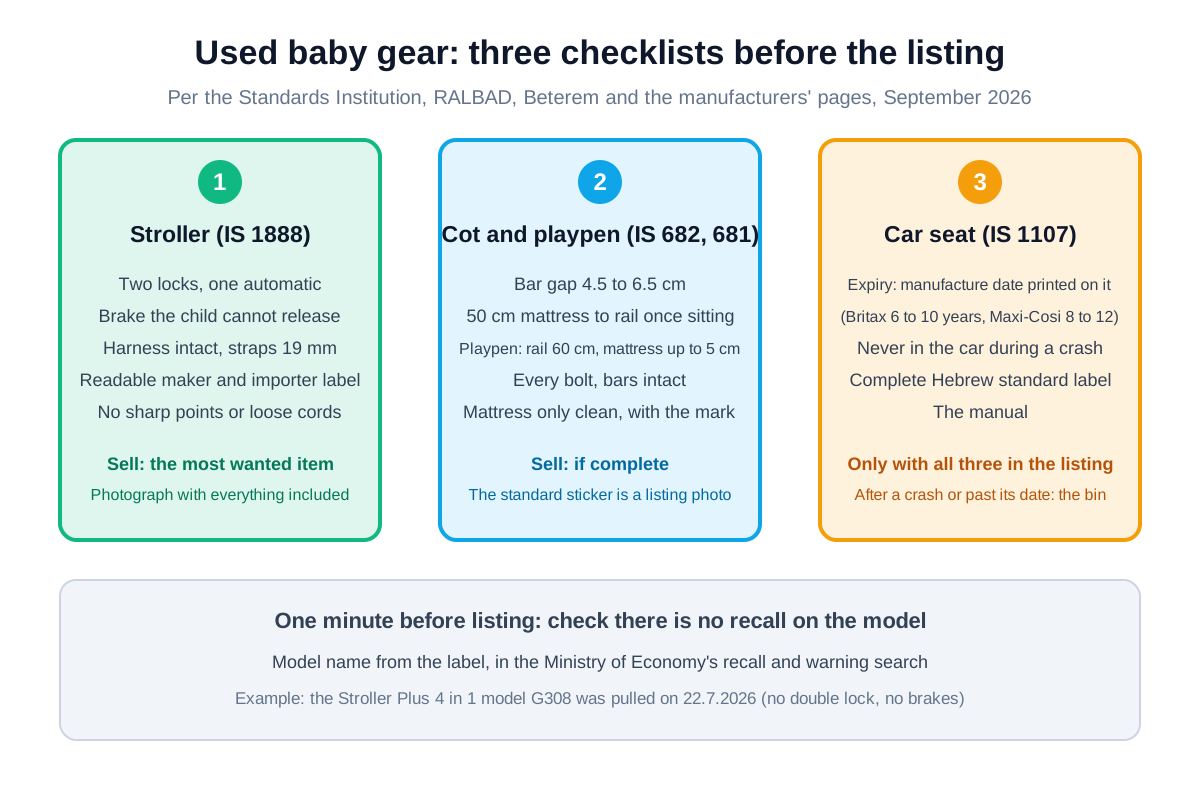
Sort first: what sells, what is given away, and what stays home
A buyer of baby gear pays for two things: that the item is safe, and that it is complete. Everything else (brand, colour, age) only moves the price. Sells well: strollers from known brands, especially travel systems with a bassinet and a seat, and double strollers; wooden or metal cots and playpens with every part; high chairs; carriers; electric breast pumps (with a new personal parts kit, sold separately); baby bouncers and rockers. They cost a lot new and are used briefly, so the gap between new and used pays for both sides. Given away, not sold: baby clothes in bulk (our guide on second-hand clothes explains why), small toys, board books, cot bumpers and pillows, and a mattress that has been slept on. Not because they are worth nothing, but because the time it takes to sell them one by one does not justify the sum. One bundle listed as free disappears within a day. Stays home, and sometimes goes in the bin: a car seat that was in the car during an accident (the Standards Institution recommends replacing such a seat, and that applies to whoever buys it from you), a car seat past the date its manufacturer set, anything under a recall, and a stroller or cot missing a part without which it is unsafe (a lock, a brake, a bar). The next sections explain how you know.
Stroller: five checks the standard demands, and you do before the photos
In Israel strollers must meet a mandatory standard, IS 1888, and the Standards Institution publishes what it checks. These are exactly what a careful buyer checks on arrival, so do them first: 1. Two locks. An open stroller must be secured by at least two locking mechanisms, and one of them must engage automatically when the stroller is ready for use. Open it, listen for the click, and try to fold it without releasing: if it moves, there is a problem. This is precisely the defect that took a stroller off the shelves in July 2026 (see the recall section). 2. Brake. It must be reachable by whoever pushes and built so the child cannot release it. Lock it, push, confirm the wheels hold. 3. Harness. Straps at least 19 mm wide, intact, with no broken buckle or frayed belt, fitting every seating position. A broken harness buckle is a reason not to sell until it is replaced (importers sell parts). 4. Label. The manufacturer's name, the country of origin and the importer's details must be readable on the stroller. The buyer will search by the model written there, and you will need it for the recall check and for pricing. If the sticker has worn off, take the model from the invoice or the manual. 5. Sharp points, gaps and cords. Run a hand along the frame: no sharp points, no gaps a child's finger fits into, no loose cords that could wrap around a neck. Then clean. A stroller that sells is one that looks like the buyer would put their own child in it: fabrics through the machine if the manufacturer allows, the frame scrubbed, the wheels cleaned (hair and sand on the axles are the usual cause of a "stuck" wheel), everything dried in the sun. Reassemble and check it folds and opens smoothly. What adds value: everything that came with it. The bassinet, car-seat adapters, rain cover, mosquito net, bag, footmuff. Gather it all and photograph it together. A stroller "as you bought it" is worth more than one with "adapters somewhere too".
Car seat: the one item that is sometimes right not to sell
The law first, so you know what your buyer needs. Under regulation 83a of the traffic regulations (as RALBAD, the road-safety authority, explains it): up to age one the child sits rear-facing, up to age 3 in a car seat with an internal harness, and from 3 to 8 in a booster. The professional advice from RALBAD and Beterem is stricter: rear-facing until at least age two. When you write which range the seat is for, that is the range the buyer will check it against. Now the three things nobody can check for you: 1. Expiry. Car seats have an expiry date. RALBAD says it outright: the materials age and the seat loses strength. Manufacturers set the span: Britax say 6 to 10 years from the date of manufacture depending on the model, with the date of manufacture and expiry printed on the serial label; Maxi-Cosi say 8 to 12 years depending on the product, with a date-of-manufacture sticker on the back of the seat. Beterem add that the date is embossed on the back or the underside. Find it, photograph it, write it in the listing. A seat past its date is neither sold nor given away; it goes in the bin, preferably after cutting the harness so nobody picks it up. 2. Accident. The Standards Institution recommends replacing a car seat that was involved in an accident, and RALBAD writes that if the car was in a road accident the seat must be replaced. The damage does not show from outside. If the seat was in the car during an accident, even a minor one, it is not for sale. And if it was not, write it in the listing in those words: "never in the car during an accident". That is the line the buyer is looking for. 3. Label. In Israel a car seat must meet a mandatory standard, IS 1107, and per the Standards Institution every seat must carry a Hebrew label with the manufacturer's name, the model, the standard it was approved under, the Ministry of Transport approval date, the age or weight range, and the importer's name, address and phone. A seat without that label (for example one brought from abroad in a suitcase) is very hard to sell, and rightly so. Photograph the label close enough to read. With those three in the listing, a car seat within its date, never in a crash, with its label and manual, is a legitimate item to sell, and careful parents do buy it. Without any one of them, it is the one item in this guide that is right to keep at home.
Cot, bassinet and playpen: the numbers the buyer will measure
Here too there is a mandatory standard, and the Standards Institution publishes the numbers. A buyer who read them arrives with a tape measure, so measure first: Cot (IS 682 parts 1 and 2): the gap between the bars is 4.5 to 6.5 cm. Wider is a head-entrapment risk, narrower a limb-entrapment risk. And once the child sits up, the mattress base is lowered so that there are at least 50 cm from the top of the mattress to the rail. If your cot has two heights, that is an advantage worth writing. Bassinet (IS 682 part 3): for infants up to 3 months only, rail at least 22.5 cm above the mattress, same bar gap. A bassinet sells fast precisely because it is used for three months. Playpen (IS 681): rail at least 60 cm from the base, mattress up to 5 cm thick, and the folding lock must prevent accidental collapse. Open it, confirm the lock, try to fold without releasing. Completeness. A cot with a missing bolt is a cot the buyer will have to improvise a part for, and nobody wants to sleep on that. Count bolts and fittings against the manual (or a photo of the cot assembled), and if anything is missing, order it from the importer before listing. A cracked or broken bar: not for sale until replaced. Mattress. Infant mattresses are a mandatory standard in their own right (IS 1548), and most buyers prefer a new mattress even for a used cot. Add it to the listing only if it is clean, unstained, with the standard mark on its label, and say it is offered separately. A cot without a mattress is a perfectly legitimate listing. What the Health Ministry writes about all of these (updated 21.10.2025) is worth quoting in the listing: buying or receiving second-hand products such as a stroller, playpen, bassinet or cot that carry the standard mark is the best way to make sure the product will not endanger your children. The standard-mark sticker on your cot or stroller is therefore a photo in the listing, not a footnote.
One minute before listing: check there is no recall on the model
A recall is a call by the Commissioner of Standardization at the Ministry of Economy to stop using a product or return it, and it happens to baby products too. An example from this summer: on 22.7.2026 a recall was reported for the "Stroller Plus 4 in 1" model G308 (sold in Israel under the MeiLY+ brand as well), after Standards Institution testing found it failed IS 1888 part 1: no double locking mechanism, no braking devices, and failed stability tests. The public was told to stop using it immediately. A stroller like that may not be sold, and not given away either. The check: the Ministry of Economy's website has a search page for warnings and recalls on consumer products (link below). Type the model name from the label; if there is no result, carry on. If there is, follow the instruction in the notice (usually contact the importer for a repair or refund), and do not list it. It takes a minute, and it protects you too: whoever sells a recalled product is selling something known to be dangerous.
Pricing: no price list, one method
There is no price table for used strollers and cots, and anyone looking for one finds only other people's listings. Those listings are exactly the method. 1. Search the boards for the exact model name (from the label). Three to five listings of the same model, from a nearby year, give a range. Strollers from sought-after brands stay relatively expensive even after years, and strollers from unknown brands barely hold anything, so there is no single formula. 2. Place yourself in the range by three things: condition (faded fabric, worn wheels and scratches bring it down, even if everything works), completeness of the set (bassinet, adapters and rain cover bring it up; a missing part brings it down by more than it costs), and age (a model that has changed since, not just in colour, is worth less). 3. Check what the model costs new today, including sales. If the gap from new is small, the buyer will prefer new with a warranty. Second-hand sells when the gap justifies the risk. 4. The real test comes after listing: a week without an enquiry on a clean stroller with good photos and a price in the range is a wrong price, not "nobody saw it". Lower it once, clearly. Car seat: the same method, but understand in advance that the pool of buyers is smaller, because many parents do not buy a used car seat at all, and rightly. A relatively low price and a listing that answers expiry, accident and label are what bring the ones who do.
The listing that sells baby gear
Title: type, brand, model and year. "Bugaboo Fox 3 stroller, 2023, full set" or "Solid wood cot with two heights, 2022". The model name in the body, because that is how it is searched for. Photos: the item open and assembled, folded (stroller) or dismantled (cot, so they can see it fits in a car), the label close up, the harness and buckle, every scratch or wear mark, and everything included in the set. On a clean background, not among the toys. A 15-second video: folding and opening the stroller, locking the brake. It replaces ten messages. The safety line: for a stroller, "both locks and the brake work, harness intact". For a cot, "every bolt, bar gap 6 cm". For a car seat, "manufactured 03/2022, valid to 2028 per the manufacturer, never in the car during an accident, standard label and manual". That line is what separates your listing from all the others. Condition in plain words: "fabric washed, right rear wheel slightly worn, does not affect the ride". Things the buyer will discover anyway are better read from you. What is included: a list. "Bassinet, seat, car-seat adapters, rain cover, bag". And what is not: "no mattress" or "mattress separately". Pickup: city and neighbourhood, floor, and whether the folded stroller fits in an ordinary car. The buyers here are parents with a child in hand, and distance is a factor. On Shukshuk you list baby gear free through the chat, with no commission, and enquiries come straight to you. And what is left (clothes, toys, bumpers) goes on the "free" page (link below), one bundle, gone the same day.
FAQ
Is it allowed to sell a used child car seat?
Yes, there is no ban, but there are three conditions without which it is not right to: the seat is within the span its manufacturer set (Britax: 6 to 10 years from the date of manufacture; Maxi-Cosi: 8 to 12; the date is printed on the seat), it was never in the car during an accident (the Standards Institution and RALBAD recommend replacing such a seat), and it carries a complete Hebrew standard label. Write all three in the listing.
How much is a used stroller worth?
There is no price list. The method: search the boards for the exact model name, three to five listings from a nearby year give a range, and place yourself in it by condition, completeness of the set (bassinet, adapters, rain cover) and the model's age. Compare with the model's price new today, because beyond a certain gap the buyer will prefer new with a warranty.
What do I check on a stroller before selling?
What the standard (IS 1888) demands of it, per the Standards Institution: two locking mechanisms with one engaging automatically, a brake the pusher can reach and the child cannot release, an intact harness with straps at least 19 mm wide, a readable manufacturer and importer label, and no sharp points, finger gaps or loose cords. Then clean it, and check there is no recall on the model.
What is the standard gap between cot bars?
4.5 to 6.5 cm, per the Standards Institution (IS 682). And once the child sits up, the mattress is lowered so there are at least 50 cm from its surface to the rail. In a playpen (IS 681) the rail is at least 60 cm and the mattress up to 5 cm. Measure before the photos, because the buyer will arrive with a tape measure.
How do I check there is no recall on a stroller or cot?
The Ministry of Economy's website has a search page for warnings and recalls on consumer products; type the model name from the label. An example from 22.7.2026: the Stroller Plus 4 in 1 model G308 was taken off the shelves after failing IS 1888 (no double lock and no brakes). A recalled item is neither sold nor given away.
What do I do with a car seat that has expired or was in an accident?
Neither sell it nor give it away. Cut the harness so nobody picks it up from the pavement, and put it in the bin or out on the municipal bulky-waste day. Crash damage does not show from outside, and the materials age even without a crash; that is why RALBAD and the Standards Institution recommend replacing it.
Should I sell the mattress with the cot?
You can, separately. Infant mattresses are a mandatory standard in their own right (IS 1548), and most buyers prefer a new mattress even for a used cot. Offer it only if it is clean, unstained and carries the standard mark on its label, and write "mattress separately" or "no mattress". A cot without a mattress is a perfectly legitimate listing.
Sources
- Standards Institution of Israel, recommendations for buying and using strollers (IS 1888: double lock, brake, harness, marking; Hebrew)
- Standards Institution of Israel, recommendations for cots, bassinets and playpens (IS 682, IS 681, IS 1548: bar gap, heights, mattress; Hebrew)
- Standards Institution of Israel, recommendations for child car seats (IS 1107: label contents, replace after an accident; Hebrew)
- Ask RALBAD, which car seat at which age (regulation 83a, seat validity, replace after an accident; Hebrew)
- Beterem, car seats for infants and children (date of manufacture on the back, age advice; Hebrew)
- Ministry of Health, baby products with a standard mark (second-hand with a standard mark; updated 21.10.2025; Hebrew)
- Britax, car seat expiration dates (6 to 10 years from date of manufacture, serial label)
- Maxi-Cosi, car seat expiration (8 to 12 years, sticker on the back)
- Ministry of Economy and Industry, search for a warning or recall on a consumer product (Hebrew)
- Mako, recall of the Stroller Plus 4 in 1 model G308 (22.7.2026; IS 1888 part 1; Hebrew)

See also
The standard requirements, legal rules and manufacturer advice were read from the sources listed on 18.9.2026 and may change; the manufacturer's instructions for your own item take precedence over anything here, especially on car-seat expiry. This guide is not safety advice for a particular child and not a valuation of any particular item.